Top videos

In this clip Dr Israr Ahmed explains the essence of worship, emphasizing that it's more than just rituals like prayers and fasting. Worship entails being a devoted servant to God, obeying His commands willingly and out of love, not just out of obligation. It involves complete submission and sincere love for Allah, where every action is done to please Him. Worship combines obedience and love, reaching its fullness when one's love and submission to God are profound.

In this clip, Dr. Israr Ahmed talks about hypocrisy. He explains how the word 'nifaq' originated from Arabic and its evolution into 'munafiqat.' He uses the example of a double-faced animal to illustrate the concept. Hypocrites are those who pretend to be believers but mock faith secretly. Allah exposes their deceitfulness.

In the clip, Dr. Israr Ahmed talks about Prophet Muhammad's farewell pilgrimage speech, emphasizing the repetition of key teachings three times. He stresses the importance of spreading Islam's message, citing a verse from Surah Al-A'raf, and urges individuals to fulfill this duty to avoid accountability on Judgment Day.
In this clip Dr Israr Ahmed explains that the veil (pardah) in Islam has roots in pre-Islamic Arabian culture, where women covered their bodies but not always their heads or faces. Islam refined this practice into a religious requirement. He stresses that hijab is based on the traditions of the Prophet Muhammad (SAW) and is essential to Islamic culture, and these traditions must be followed for spiritual growth.
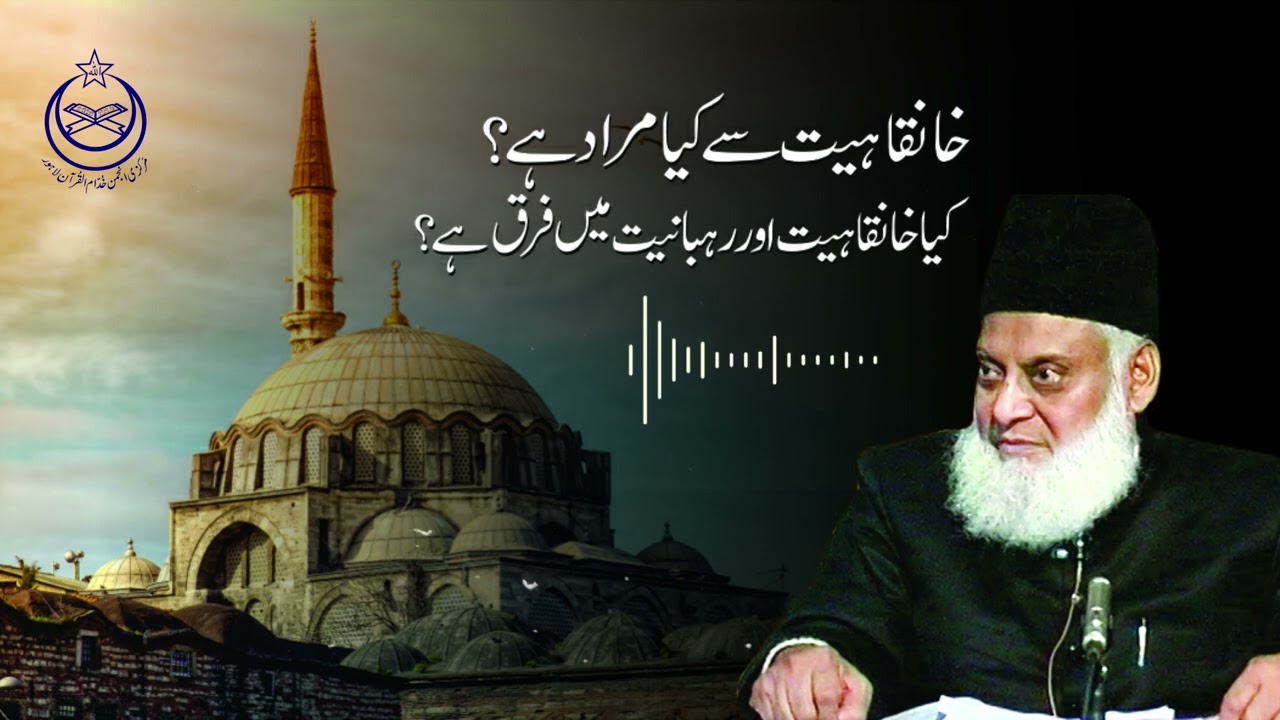
In this clip Dr Israr Ahmed explains that khanqahiat in Islam means spiritual centers focused on inner growth and helping others, without needing to leave worldly life. Rahbaniyat, on the other hand, involves complete withdrawal from society. Khanqahs (spiritual centers) have been important in spreading Islam and guiding Muslims while staying connected to society.

In 1985, Dr. Israr Ahmed organized a six-day event discussing a religious vision derived from the Quran with 100 scholars. Among them, Maulana Waheed-ul-Deen Khan remained silent when questioned about the importance of peace versus war, simply replying, "No Comments" in English. This exchange highlighted differing perspectives on conflict resolution within the religious community.

In this clip Dr Israr Ahmed explains that after an Islamic revolution, the ideal system should be based on the Quran, Sunnah, and the Khilafat-e-Rashida. He says the focus should be on these, not on any specific school of thought (fiqh). However, if a fiqh like Hanafi takes over, he would accept it as better than the current system. He also points out that discussions in Pakistan have always focused on the Quran and Sunnah, not on any one fiqh.
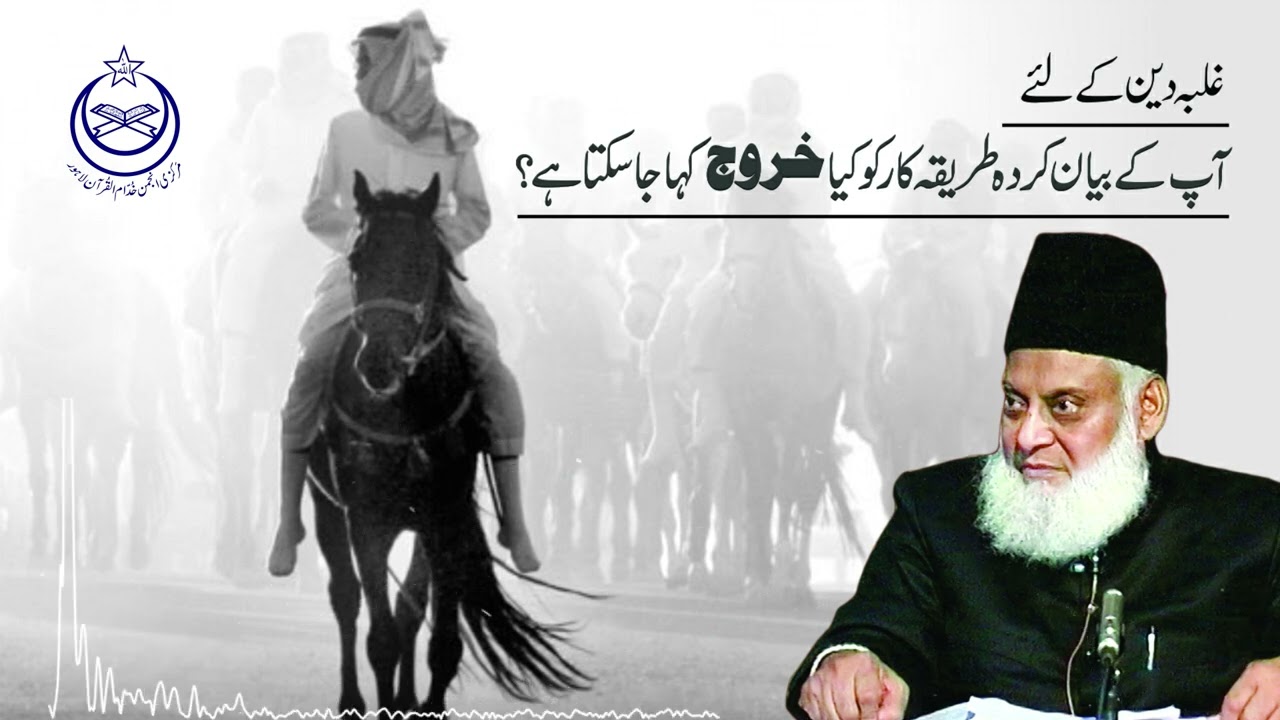
In this clip Dr Israr Ahmed explains that achieving change through non-violent methods, like Gandhi’s movement against the British, is not rebellion. After World War II, the British left India peacefully, as they couldn’t stay due to external pressures. Despite conflicts between Hindus and Muslims, no British were harmed during the independence struggle.

In this clip Dr Israr Ahmed explains that Allah's knowledge of our actions doesn’t take away our free will, so accountability is still necessary. He stresses paying Haq Mehr right after marriage, discusses the issue of three talaqs, and highlights Hazrat Umar’s rulings. He says patang bazi is allowed if done safely but criticizes it as a harmful cultural practice. He also talks about women's rights, in-laws being mahram, and sharing family responsibilities fairly.

In this clip, Dr Israr Ahmed is explaining that Allah is angry with poeple who themselves do prayers, and good deeds but do not convey the commands of Allah and Islam to others and they see the spectacle of their sins in front of them but they do not stop them, So such people are not worshipful scholars but such people have been called great criminals and wretched by Allah.

In this clip Dr Israr Ahmed outlines Islam with two facets: "religion" and "way of life." The term "mazhab" is absent in the Quran, applied to sects like Hanafi, Maliki, etc. True religion aligns with Allah's law, Sharia. Those diverging are deemed misguided.

In this clip Dr Israr Ahmed talks about secularism and liberalism, which mean keeping religion separate from public life. Secularism allows people to believe what they want without it affecting government, while liberalism focuses on personal freedom and keeping religion out of politics.

In this clip Dr Israr Ahmed discusses the challenges of balancing modern education and religious struggle. He emphasizes the need for personal commitment and passion in overcoming distractions and obstacles. By prioritizing faith and being prepared to answer to Allah, individuals can find strength and success in their religious journey, even amidst difficulties.

In this clip, Dr. Israr Ahmed discusses the importance of conveying Allah's message to others. He explains that as servants of Allah, it's our duty to share His teachings and guide people toward worship. The Quran uses terms like "tableegh" and "dawah" to describe this process. Dr. Israr Ahmed also highlights how even the Prophet Muhammad (SAW) was reminded to fully convey Allah’s message and not to ignore any part of it, emphasizing the importance of reaching out to everyone, including those who might seem less important.

In this clip Dr Israr Ahmed explains the concept of overall and specific superiority. Prophet Muhammad ﷺ is the greatest of all prophets, but some, like Musa (AS), Isa (AS), and Ibrahim (AS), had unique qualities. Musa (AS) spoke directly to Allah, Isa (AS) performed unmatched miracles, and Ibrahim (AS) was Allah’s close friend and leader for humanity. Among the Sahaba, Hazrat Abu Bakr Siddiq (RA) holds the highest rank, but others had specific strengths. This shows the balance of general greatness and individual distinctions in Islam.

Dr. Israr Ahmed says the most successful people are those who learn and teach the Quran. He emphasizes believing in and understanding its importance. In short, he urges reading and understanding the Quran for success and guidance.

In this clip, Dr Israr Ahmed talks about whether Prophet Muhammad (PBUH) was light or human. He says every person has a light inside, which is their soul. On Judgment Day, believers will have a unique light. Abu Bakr's light will be strong, but hypocrites won't have any light. The Prophet's spiritual light is greater than his human side. Dr. Israr Ahmed believes Prophet Muhammad (PBUH) was both light and human, denying one or the other is wrong.

In this clip Dr Israr Ahmed stresses the significance of believing in the afterlife (Iman Bil Akhirah) and the fear of the Day of Judgment. He asserts that this belief is crucial for guiding people to act righteously. Without it, faith becomes shallow and actions can become corrupt. True faith in Allah and following the Prophet require a sense of accountability in the afterlife. Without this, religious practices become mere rituals. This understanding is vital for maintaining ethical behavior and sincere faith.

In this clip Dr Israr Ahmed explains that differences in certain Islamic practices, like prayer details, reflect flexibility within Islam rather than division. The core elements of worship are consistent across groups, keeping Muslims united. He emphasizes respecting these minor differences, as they align with the Prophet's (PBUH) example, and warns against letting differences disrupt unity.
In this clip Dr. Israr Ahmed explains Surah Al-Asr, a small but powerful surah. It summarizes the Quran's message of Tawheed, the oneness of God, and Sirat-e-Mustaqeem, the straight path. This surah is crucial to our faith, and reflecting on it can guide us. Its message is enough to lead us on the right path.