Top videos
In this clip Dr Israr Ahmed explains that a Muslim is someone who follows the main practices of Islam, like praying and fasting, making them outwardly Muslim. A Momin is a true believer whose heart is fully committed to Islam, acting with deep faith and dedication. In short, a Muslim performs Islamic duties, while a Momin believes and lives them with full sincerity.
In this clip Dr Israr Ahmed reflects on his discussions with Tablighi Jamaat leaders, acknowledging their achievements but questioning their success. He shares his experience of being involved with them for two years before parting ways due to differences. He points out the sectarian divisions within Islamic groups. He also criticizes how politics has shifted their focus from religious duties.

In this clip Dr Israr Ahmed explains that in Islam, the most important duty at a given time takes priority. Ignoring it, even for other good deeds, holds no reward. For example, during a battle, fighting is necessary, and personal worship at that time would not be rewarded. Rewards depend on fulfilling the right responsibility in the right situation.

In this clip Dr Israr Ahmed recounts three stories from Hazrat Umar's (RA) caliphate, emphasizing justice, accountability, and simplicity in governance. He highlights instances of ordinary people questioning authority and scholars teaching leaders about justice.

In this clip Dr Israr Ahmed talks about facing Allah's tests and staying strong. He shows that everyone, rich or poor, has struggles. He emphasizes the mental challenges of the wealthy and the physical hardships of laborers. Through parental worries, he highlights life's difficulties. Ultimately, he reminds us of being accountable to Allah.
In this clip Dr Israr Ahmed explains that today’s leader of an Islamic state should be chosen through consultation (mashwarah), not nomination. In the past, leaders were selected based on merit and consultation among the companions of the Prophet (SAW). Today, there is no clear hierarchy among Muslims, so leadership should be based on collective discussion rather than nomination, as seen in the selection of Hazrat Abu Bakr and others.

In this clip Dr Israr Ahmed explains that an Islamic government cannot be established without sacrifice. While peaceful efforts like education and organization are important, true change requires replacing the current system, which often involves bloodshed. Only those who practice Islam in their lives can unite to bring real change. Simple elections cannot create an Islamic system.

In this clip, Dr. Israr Ahmed talks about the Shia-Sunni conflict and how it can be resolved by focusing on shared respect for the Prophet's companions. He says that until people stop disrespecting important figures like Hazrat Ali and Hazrat Fatima, the conflict will continue. He emphasizes the need for unity and suggests that harmful practices like public mourning should stop to bring peace.

In this clip Dr Israr Ahmed discusses Hazrat Umar Farooq's (RA) leadership, He emphasizing his humility and accountability. He questions Muslims' role in wars and recounts when Iranian Muslims became allies. Hazrat Umar's (RA) simplicity is evident in his lack of personal guards, and his commitment to honesty is shown by personally searching for missing funds.

In this clip Dr Israr Ahmed explains that identifying as Muhammad's (SAW) followers requires rejecting false beliefs. He lists four crucial conditions for salvation: faith alone isn't enough; being Muhammad's (SAW) followers ensures it. Being Muslim and Muhammad's (SAW) followers guarantees salvation.
In this clip Dr Israr Ahmed says it's not proven from the Prophet (PBUH) or his companions to ask Allah by mentioning the Prophet's name in prayers. He warns that adding such practices can lead to confusion. The safest way is to pray like the Sahaba did and stick to their methods, as religion should be based on the actions of the Prophet (PBUH) and his companions, not later additions.

In this clip Dr Israr Ahmed talks about the respect due to a son-in-law in Islam and the consequences if a wife disobeys her husband. He explains that a wife should respect her husband, and failing to do so can be a sin. He also discusses the importance of treating a son-in-law with honor while maintaining fairness. Regarding charity, Dr. Israr Ahmed says one can donate up to one-third of their wealth for good causes. Lastly, he encourages starting with obligatory prayers and gradually increasing one’s religious practices.
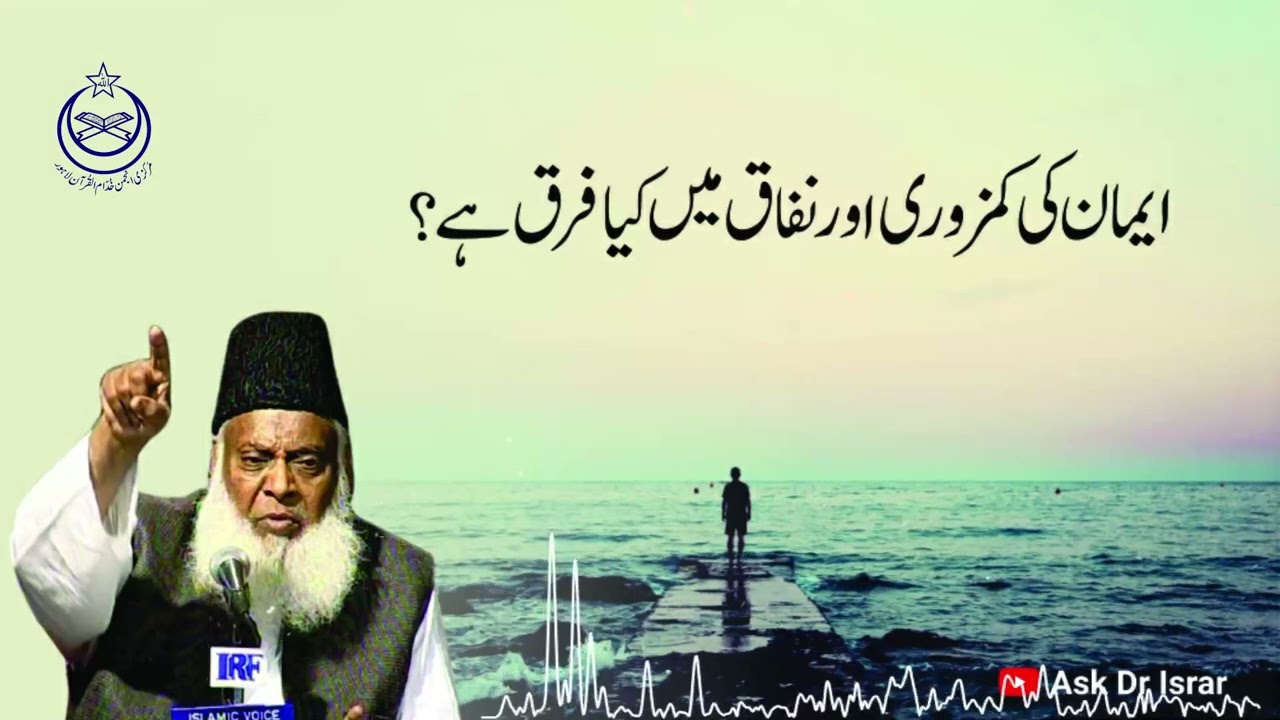
In this clip Dr Israr Ahmed explains the difference between weak faith and hypocrisy. Weak faith leads to a lack of passion in worship and adherence to Shariah but involves self-awareness and efforts to improve through repentance. Hypocrisy, however, includes actions that contradict faith or deliberate hostility towards Islam and sincere believers. Hypocrites hide their true intentions, develop jealousy, and oppose those dedicated to Islam. Weak faith is an internal struggle, while hypocrisy is marked by deceit and defiance.
In the clip, Dr. Israr Ahmed talks about how Allah will honor and elevate nations through the Quran, while those who ignore it will face disgrace. He stresses that the Quran is crucial for Muslims, and neglecting it leads to humiliation. Dr. Israr highlights the Quran's role in guiding and shaping civilizations, emphasizing its significance in human history.

In this clip Dr Israr Ahmed explains that Islam is based on both the Quran and the Sunnah (teachings of Prophet Muhammad SAW). The Quran provides guidance, but it is the Sunnah that explains how to put that guidance into practice, such as how to perform prayers. Both are necessary to establish Islam as a complete way of life, including its social, political, and economic systems. The purpose of Prophet Muhammad's mission was to implement and make this complete system of life, known as Deen-e-Haq, supreme over all other systems.

In this clip Dr Israr Ahmed clarifies the difference between sadqa and qarz-e-husna. Sadqa refers to voluntary donations given to help the poor, orphans, and those in need. In contrast, qarz-e-husna is a loan provided to support efforts that promote Islam and its teachings. Essentially, sadqa aids individuals directly, while qarz-e-husna focuses on strengthening the faith and community.

In this Dr Israr Ahmed reflects on the slow growth of Tanzeem-e-Islami, emphasizing that success depends on Allah's will. Despite the group's 26 years of existence, progress has been limited, similar to the struggles faced by Hazrat Nuh (AS) and Prophet Muhammad (SAW). He argues that human efforts are fallible, and mistakes can happen. Dr. Israr Ahmed also highlights the importance of focusing on the long-term goal rather than questioning the pace. Constructive efforts are more valuable than merely pointing out flaws.

In this clip Dr Israr Ahmed explains that giving three divorces in one sitting is valid but considered sinful. Hazrat Umar (RA) enforced this rule to discourage its misuse but also punished those who practiced it. The preferred method is to give one talaq at a time, allowing for reconciliation during the iddah period. Three divorces at once finalize the separation, leaving no room for remarriage unless the woman marries and divorces another man naturally.

Dr. Israr Ahmed discusses the importance of distinguishing between right and wrong, trust and betrayal, according to Allah's commands. He warns against betraying Allah by disregarding what is lawful and unlawful. If you resort to illegitimate means to fulfill desires, you won't be rewarded. True reward comes from obeying Allah.