Top videos

In this clip Dr Israr Ahmed explains that Allah sent His messengers with clear guidance to help establish justice. The goal is for people to live fairly, where everyone gets their rights and fulfills their duties. Without justice, religious acts like prayer and fasting lose meaning. The main purpose of Islam is to create a system of justice, as taught in the Quran and by Prophet Muhammad (SAW).

In this clip Dr Israr Ahmed explains that while many religious texts claim to be divine, only the Quran has been preserved in its original form, which even non-Muslims acknowledge. Other scriptures, like the Torah and Bible, have been changed or lost over time, according to their own followers. Dr. Israr Ahmed also mentions that translating the Quran is difficult because translations may not fully capture its original meaning.

Ancient Time Story in Quran | 2 Logon Ka Qissa | Bagh Walon Ka Waqiya | Faith In Allah By Dr Israr
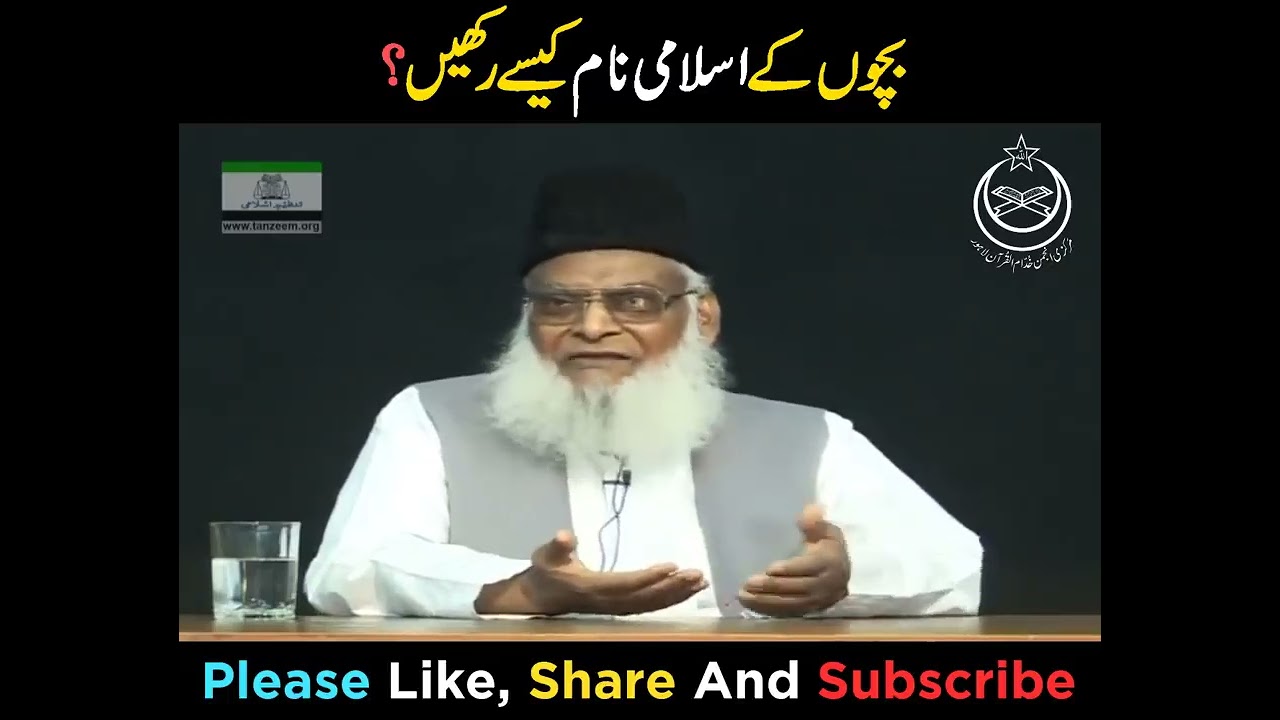
In the video Dr Israr Ahmed explains how to choose good Islamic names for children. He says to pick names without bad meanings or connections to other gods. Instead, go for names like "Abdullah" instead of "Abdul Rasool" for better meanings.

In this clip Dr Israr Ahmed explains that, in Islam, a woman’s main role is to care for her family, while the husband provides financially. Women can work if they follow Islamic guidelines, like wearing hijab. He suggests women-only workplaces, like hospitals and schools, to keep things modest and aligned with Islamic values.

The clip shows Dr. Israr Ahmed urging Muslims to unite, prioritize honesty, integrity, and follow Islam's teachings. He emphasizes the Quran's importance and Prophet Muhammad's exemplary character, urging Muslims to fulfill their faith and societal responsibilities with sincerity, drawing inspiration from the Prophet's farewell sermon.

In this clip, Dr Israr Ahmed is talking about what happens after death in Islam, especially regarding Prophet Muhammad's status in his grave. Some believe he's spiritually alive, while others disagree. Different scholars emphasize life after death, causing disagreements among groups. The speaker emphasizes following the Prophet's teachings and trusting in Allah.

What Is Shirk Part 2 | Types of Shirk In Islam | Lecture In Chicago USA | Dr Israr Ahmed Official
Dajjal Kab Aayega | Prediction About Dajjal | Dajjal Ki Nishaniyan | Fitna Dajjal By Dr Israr Ahmed

In this clip, Dr. Israr Ahmed explains that Allama Iqbal, who was not a traditional religious scholar, is a powerful example of the Quran's miraculous impact. Despite being educated in Western universities during a time of strong Western influence, Iqbal deeply connected with the Quran and used it as the foundation for his philosophy and poetry. Dr. Israr Ahmed highlights that Iqbal's life shows how the Quran remains a living miracle, even in modern times.

In this clip, Dr Israr Ahmed talks about how the Taliban started in Afghanistan during a tough time, at first trying to bring peace. But things changed, showing they lacked education and became extreme. Dr. Israr Ahmed talks about how they got linked with Al-Qaeda and the problems after 9/11. It's a sad look at the Taliban's story, from wanting to change things to being disliked around the world.

In this clip Dr Israr Ahmed explains that both Hinduism and Islam share similar views on the soul and spirituality. He notes that Iqbal’s philosophy of self, influenced by Surah Hashir, is deeply rooted in the Quran. According to Iqbal and his associate Nazir Riazi, true self-awareness involves understanding one’s spiritual essence rather than focusing solely on physical needs. This spiritual perspective is a key aspect in both religions, contrasting with materialistic views.

In this clip Dr Israr Ahmed talks about tawbah (repentance), saying it should be sincere. When believers truly repent, Allah will forgive their sins and improve their character. On Judgment Day, the light of their faith and good deeds will vary, with some having more light than others. Believers should ask Allah to increase their light and complete their forgiveness. Even if someone has sinned a lot, Allah’s kingdom is unaffected and He remains forgiving.

In this clip Dr Israr Ahmed explains that even though Muslims are many and have resources like oil, they still face humiliation. Their blood is being shed in places like Palestine and Kashmir, but it seems worthless. For over 50 years, Muslims have been oppressed and haven't fought back. This weakness and fear are why they continue to face disrespect around the world.

In this clip Dr Israr Ahmed talks about the three levels of certainty in faith: knowing something is true (Ilm-ul-Yaqeen), seeing it for yourself (Ain-ul-Yaqeen), and fully experiencing it (Haqq-ul-Yaqeen). He explains this with a Hadith where worshiping Allah as if you see Him makes your faith stronger and more sincere.
In this clip, Dr Israr Ahmed talks about Hazrat Umar (A.S)'s time, emphasizing fair leadership and accountability. Dr israr Ahmed also shows how Umar listened to people's problems and chose capable leaders. Dr. Israr also shares stories of Hazrat Umar (A.S) standing up for justice, like punishing someone for disrespecting their mother. He criticizes leaders who forget these values and insists on a system that respects everyone.

In this clip Dr Israr Ahmed explains that Islam teaches us to encourage good and stop bad actions. He says it's not just about giving orders but also advising people. He discusses how Muslims should use their power to enforce these values, especially when they have authority. He also mentions the challenge of avoiding interest in business and stresses that leaders must ensure Islamic teachings are followed.

In this clip Dr Israr Ahmed explains that many Muslims focus on prayers and fasting but often ignore honesty and fairness in their daily lives, especially in business. He criticizes how people engage in wrong practices like lying and using interest while following religious rituals. He urges Muslims not to accept or support the current unfair system and instead work to bring an Islamic system based on justice and truth.

In this clip Dr Israr Ahmed explains that Prophet Muhammad (PBUH) took the pledge (bay'ah) in Medina as a ruler, focusing on governance and laws. In Mecca, there was no formal pledge, as the community was still forming, and it was more about faith. He emphasizes that formalities should have real meaning, not just be done as rituals.

In this clip Dr Israr Ahmed explains that shirk, or associating partners with Allah, is a severe wrongdoing with three main types: shirk in belief (misconceptions about Allah), shirk in actions (acting as though others share in Allah's authority), and shirk in attributes (attributing divine qualities to others). He highlights that shirk is the opposite of Tawhid (pure monotheism) and is an unforgivable sin according to the Quran. This concept is fundamental in understanding the gravity of placing anything or anyone in Allah's divine position.