Toppvideor

In this clip Dr Israr Ahmed stresses that true prayer involves a deep spiritual connection with God, not just performing outward rituals. He criticizes focusing solely on external practices while neglecting inner devotion and presence of heart. True worship should evoke a genuine feeling of God's presence. Without this, religious practices remain superficial. He calls for balancing outward rituals with inner spirituality.

In this clip Dr Israr Ahmed says that after Friday prayers, it’s fine to return to work. Islam teaches that our earnings are blessings from Allah, not just from our own efforts. Just as a worker might get extra money as a favor, our sustenance is a gift from Allah. It’s important to see it as a blessing, not something we solely earn through work.

Dr. Israr Ahmed highlights the importance of faith and Islam, distinguishing between partial and total obedience in Islam. He clarifies the contrast between self-obedience and obedience to Allah, stressing its significance for believers.
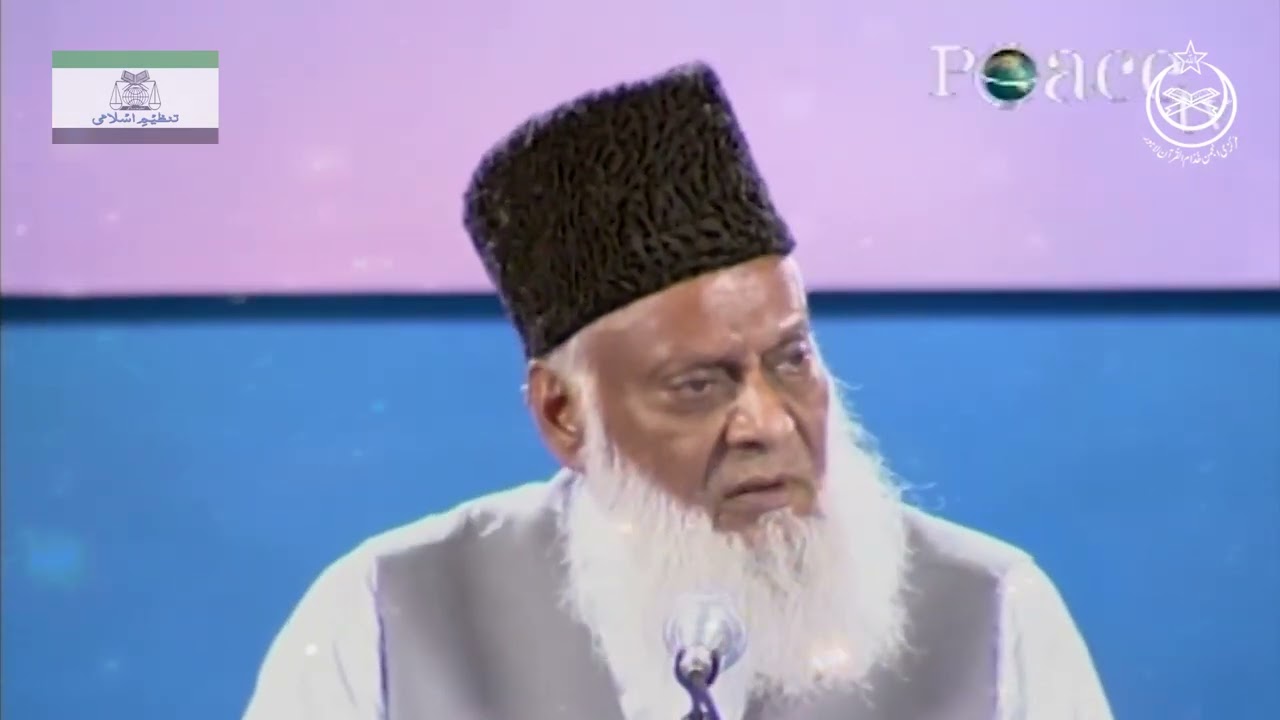
In this clip Dr Israr Ahmed explains that to establish Allah's system, a united group (jamaat) is necessary. Without this group, it's difficult to maintain the right path and achieve global justice. He emphasizes that having a strong, organized community is essential for implementing a just system and achieving the goals of Islam, including global leadership and justice.

In this clip Dr Israr Ahmed explains that obedience has two parts: individual and collective. In organized societies with strong laws, people have less individual freedom and must follow collective rules. In simpler societies, people have more personal freedom and fewer collective rules. Some actions can be controlled individually, while others depend on changes in society. In well-organized societies, individual actions are limited by the laws and norms of the state.

In this clip Dr Israr Ahmed explains that the greatest jihad is fighting against your own desires (nafs). He describes how resisting laziness, like getting up for prayer, is a form of this struggle. He also warns against making your desires your god, which is a form of shirk (associating others with Allah).

In this clip Dr Israr Ahmed describes how Tanzeem-e-Islami trains members through a 7-day introductory program, regular assessments, and weekly meetings focused on Quranic teachings. While there is no open resistance to the group, members often face personal challenges at home due to lifestyle changes, like leaving certain jobs or adopting conservative practices. This personal transformation creates indirect resistance within society.

In this clip Dr Israr Ahmed explains that seeking help from anyone other than Allah is considered shirk (associating partners with Allah). While it's permissible to ask for practical help from others in everyday matters, asking for divine aid or intervention from anyone other than Allah, such as saints or angels, is not allowed. The proper approach is to pray directly to Allah, who has promised to respond to such prayers.

In this clip, Dr. Israr Ahmed explains that Islam is meant to bring a complete change to society, not just small adjustments. He criticizes Pakistan for only partially implementing Islamic values and emphasizes the importance of following the example of Prophet Muhammad (SAW) to bring real change. Dr. Israr believes that while it may take a long time, the process must stay true to Islamic principles rather than using modern political methods like elections.

In this clip Dr Israr Ahmed talks about the struggle to avoid sins and the guilt that comes with them. He advises reading and understanding the Quran in Arabic for a stronger faith. True repentance means sincerely deciding not to repeat the sin, and it's essential to seek forgiveness for wrongs done to others, as Allah cannot compensate for those.

In this clip Dr Israr Ahmed discusses the challenges of promoting Islam, especially for poor people. He asks if those who can only give a little time are fulfilling their religious duties. He highlights the importance of self-assessment: how you see yourself, how others see you, and how Allah sees you. He also emphasizes that Allah doesn’t give anyone more responsibility than they can handle and encourages people to contribute to Islam if they can improve their lives.

In this clip Dr Israr Ahmed talks about why Jews consider "undh" (camel) meat forbidden and how it's slaughtered differently. He explains that it's not just about cutting its throat but striking its neck bone while it stands, symbolizing its unique status. He also mentions Prophet Yaqoob's aversion to undh (camel) meat.

In this clip Dr Israr Ahmed believes that everyone should have a purpose in life and strive for excellence. He emphasizes the importance of setting goals and pursuing them diligently, regardless of one's background or circumstances. According to him, a person's worth is determined by their character and moral integrity, not material possessions.

In a 1990 lecture, Dr. Israr Ahmed warned about moral decline and counterfeit medicines in Pakistan. He urged Pakistan and India to boost their defenses and collaborate against shared threats, He emphasizing unity among Muslims. Dr.Israr Ahmed advised caution in dealings with China and stressed the significance of faith and righteous actions. He highlighted the need for awareness of true enemies and urged steadfastness in upholding Islamic principles.

In this clip, Dr. Israr Ahmed explains that while previous prophets had temporary miracles, Prophet Muhammad's (PBUH) greatest and everlasting miracle is the Quran. Unlike other miracles that ended with the prophets, the Quran remains a living miracle and proof of his prophethood. It serves as a continuous challenge to humanity and is meant to last until the end of time. This makes it unique among all prophetic miracles.

In this clip Dr Israr Ahmed discusses the Quran's unmatched eloquence and literary beauty. He explains that while everyone can appreciate its message, only native Arabic speakers, especially those from the Prophet's time, can fully understand its linguistic brilliance. Even the best poets of that era admitted they couldn't match the Quran's eloquence.

In this clip Dr Israr Ahmed explains that in the Quran, spending in the way of Allah despite loving one's wealth is emphasized. It is not about giving out of love for Allah, but rather giving despite the love for wealth. Wealth and possessions are naturally beloved to humans, but true sacrifice is spending in the way of Allah against this love. This act of spending despite loving wealth is a form of striving and self-discipline in Islam.

In this clip Dr Israr Ahmed is saying that love for Allah, His Messenger, and striving in His cause should be greater than any worldly love, like love for family, wealth, or possessions. If these worldly loves are stronger, then one is not truly devoted to Allah and won't find guidance or true connection with Him.

In this clip Dr Israr Ahmed highlights that Surah Al-Asr, one of the shortest surahs in the Quran with just three verses, is highly significant for its comprehensive guidance. Despite its brevity, it encapsulates profound wisdom and was often recited by the Prophet Muhammad’s (SAW) companions before parting as a reminder of its importance.

In this clip Dr Israr Ahmed explains that Muslims have a great task to perform acts of charity and obey Allah. Charity isn’t just about giving money; it includes creating institutions to help those in need, like shelters and providing basic necessities. Muslims are also responsible for guiding others to avoid spiritual harm and preparing for the afterlife. The ultimate goal is to save people from the punishment of hell and remind them of the true purpose of life, which is to prepare for the hereafter.