Top videos

Is this clip, Dr Israr Ahmed highlighted Prophet Muhammad's (pbuh) unwavering dedication to spreading Islam as depicted in the Quran, comparing his efforts to previous prophets. He emphasized how Prophet Muhammad's mission resulted in the triumph of Islam across Arabia, showing his role as a messenger for all humanity, offering both guidance and warning.

In this clip Dr Israr Ahmed suggests that Israel was behind the 9/11 attacks to intimidate the U.S. and prevent interference in its affairs. He believes Israeli agents have infiltrated key sectors of the U.S. and that Israel avoids putting too much pressure on Pakistan to prevent backlash. He is convinced that Israel's influence is responsible for the attacks to maintain its control and dominance.

In this clip Dr Israr Ahmed criticizes modern laws that conflict with Islamic teachings, such as those legalizing same-sex marriages. He argues that these laws, influenced by global organizations, go against the principles of Islam. He stresses that Islam aims to establish a system based on God's laws, not human-made ones.

In this clip Dr Israr Ahmed talks about avoiding interest-based systems like banks and suggests partnerships based on fairness instead. He says until interest systems are gone, there can't be alternatives. He warns against even indirect involvement with interest and urges changing the system.

In this clip Dr Israr Ahmed talks about the essence of true goodness and patience, using stories from the battles of Ahzab and Tabuk. He emphasizes the patience endured by the companions during tough times, like the blockade of Banu Hashim and the scarcity of resources in Tabuk. He highlights the selflessness and sacrifice of the companions, who endured hunger and hardships for the sake of truth.

Dr. Israr Ahmed talks about his 40 years of work for Islam. He joined Jamaat e Islami but left when they decided to do politics. He started Anjuman Khuddam al-Quran to teach Islam in Pakistan.

In this clip Dr Israr Ahmed discusses working for Islam with a focus on trusting in Allah and perseverance. He stresses the significance of prayer, contentment, and relying on Allah's will. Though hard work is crucial, outcomes are ultimately up to Allah. Despite setbacks, one should persist in their duties and trust in Allah's guidance for success.

In this clip Israr Ahmed discusses the fate of hypocrites and narrates the story of Abdullah bin Abi's death and funeral. He also elaborates on the exemplary character of the Prophet Muhammad (SAW). Hypocrites have no good deeds accepted, and Abdullah bin Abi's prayers may not have been accepted despite being led by the Prophet (SAW).
In this clip Dr Israr Ahmed discusses Hazrat Umar Farooq's (RA) martyrdom and Yum-e-Shahadat Yakam Muharram, 1384 years ago. Hazrat Umar (RA) was attacked by Abu Lulu Feroz, an Iranian slave, during his leadership. Before his martyrdom, Hazrat Umar (RA) enforced a tax rule for slaves, causing dissent. He then ordered the creation of a millstone in response.

In this clip Dr Israr Ahmed explains that on the Day of Judgment, everyone will be asked about five things: how they spent their life, used their youth, acted on their knowledge, managed their wealth, and performed good deeds. More resources and knowledge mean stricter accountability.
In this clip, Dr. Israr Ahmed emphasizes that Allah loves those who strive and fight for His cause. He highlights two elements of Jihad and shares the five actions the Holy Prophet (peace be upon him) instructed Muslims to follow: joining the community, listening, obeying, migrating, and engaging in Jihad for Allah's sake

In the clip, Dr. Israr Ahmed talks about two kinds of love: love for Allah and love for worldly things. He warns about the consequences for those who prioritize the love of worldly things over the love of Allah

In this clip, Dr Israr Ahmed emphasizes never losing hope in Allah's love and mercy. He stresses that true assistance comes from Allah alone, urging loyalty to His cause even in the face of worldly rebellion. Quoting Surah Ar-Rum, he highlights the need for patience, assurance, and proving steadfastness to deserve divine help.
In this clip Dr Israr Ahmed explains that in financial matters, a man’s testimony equals two women’s as per Allah’s command. He suggests this is due to women’s natural tendency to forget, designed by Allah for their supportive roles, with forgetfulness acting as a safeguard to help them move on from past experiences.

In this clip, Dr Israr Ahmed beautifully underscores the Quranic duty of Hajj, urging those capable to embark on this sacred journey. He poignantly portrays it as a debt owed to Allah, emphasizing unity among Muslims, witnessed during his own transformative pilgrimage from Madina to Mecca, where sectarian barriers fade, and all unite in prayer.

Dr Israr Ahmed Life Changing Bayan | Who is Momin | Momin Ki Nishaniyan | Momin Ki Pehchan

In this clip Dr Israr Ahmed explains that the Quran was preserved by Prophet Muhammad (SAW) through memorization and recitation as instructed by God. The written compilation of the Quran into a book was done later by Hazrat Abu Bakr and Hazrat Usman (RA). The initial preservation was through the Prophet, and the misunderstanding that Hazrat Usman (RA) compiled the Quran is incorrect.
In this clip Dr Israr Ahmed explains that mahfil-e-sama is allowed in Islam with certain rules. It should focus on Qur'an recitation, Allah's praise, or spiritual poetry, delivered in a good voice. The Prophet (PBUH) encouraged listening to the Qur'an, which deeply moved him. The reciter must be a mature man, not a child or effeminate, and no musical instruments should be used. The goal is to inspire faith and spirituality in a lawful way.
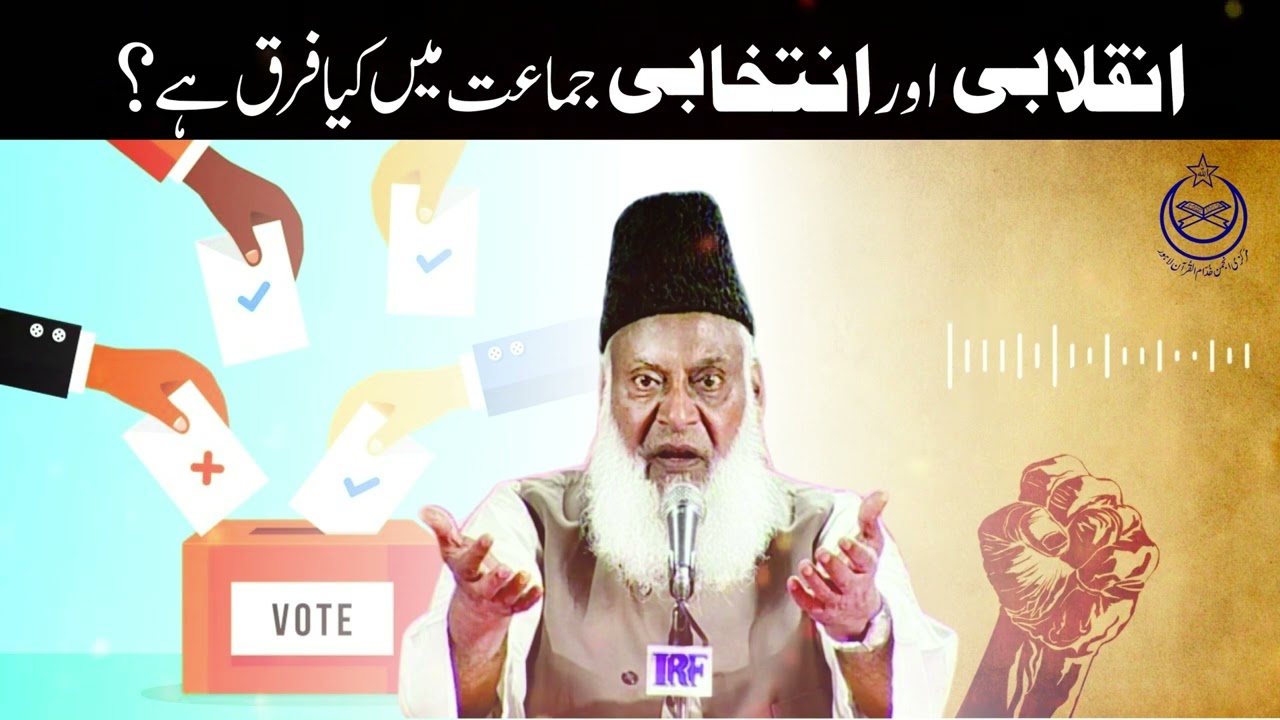
In this clip Dr Israr Ahmed explains three types of groups. Tablighi Jamaat focuses on personal reform, spreading religious teachings, and avoids politics. Intikhabi Jamaat aims to change leadership through elections, working within the current system. Inqilabi Jamaat seeks to transform the entire system through revolutionary efforts. He distinguishes between theoretical politics, which analyzes problems and proposes solutions, and practical politics, which involves actions like elections. While both are important, theoretical politics is foundational for meaningful change.

In this clip Dr Israr Ahmed says that real life is in the afterlife, and this world is temporary and deceptive. Islam teaches us to use this life to prepare for the next, without renouncing it. We should prioritize the afterlife and ensure our actions here lead to eternal rewards. A balanced approach between worldly life and preparing for the afterlife is essential.