Top videos

In this video, Dr. Israr Ahmed talks about faith and Islam, explaining different levels of faith: legal and true faith. He also discusses the connection between faith, righteous deeds, and God.

In this clip, Dr. Israr Ahmed explains how ego can be destructive and cites examples from the Quran to emphasize the importance of humility. He mentions that walking with humility and moderation is favored by Allah, while arrogance and extravagance are disliked. He highlights the importance of choosing a middle path in all circumstances, avoiding both extreme frugality and wastefulness.

In this clip Dr Israr Ahmed discusses hypocrisy in Islam, noting signs and misconceptions. He warns against opposing religious establishment and misunderstanding jihad's importance. He emphasizes the need to recognize and avoid hypocritical behavior among Muslims, urging adherence to religious obligations.

In this clip Dr Israr Ahmed explains that the Khutbah in a Nikah is meant to provide guidance and renew faith, not just be a ritual. It praises Allah, seeks His forgiveness, and confirms belief in Him and the Prophet (PBUH). The Khutbah has three parts: two are traditional and one added later. Its goal is to remind us of our faith and good character. Understanding its message is important, rather than just performing it as a formality.

Dr. Israr Ahmed shares the Prophet's (S.A.W) message of good news to his Ummah, discussing whose faith is high and acceptable according to a hadith. He also delves into the three elevated and beautiful levels of attaining faith.

In the clip, Dr Israr Ahmed emphasizes the importance of unwavering faith in Allah and the futility of fearing anything besides Him. Believers find solace in knowing that Allah is their protector and guardian, and nothing can harm them without His permission. He underscores the power of faith in Allah's sovereignty, which brings peace even in unseen circumstances.

In this clip Dr Israr Ahmed says the greatest Sunnah of Prophet Muhammad (SAW) is promoting marriage, aligning with human nature. He emphasizes that true followers support this Sunnah, and the Prophet’s key teachings are spreading Allah’s message and striving to establish Islam.

In this clip Dr Israr Ahmed talks about how the Quran mentions instant heavenly rewards using the term "nuzul" in Arabic. He compares it to serving guests right away, saying in paradise, amazing delights will be ready instantly. These blessings are only for believers and are too great for us to understand. Dr Israr Ahmed says real happiness comes from these gifts, not from worldly things.

In this clip Dr Israr Ahmed suggests to someone battling with sin to strengthen their faith by delving into the Quran, learning its Arabic, and reading it directly. He advises seeking forgiveness for past wrongs, committing to stop sinning, and asking forgiveness from those harmed. He assures that Allah forgives sincere repentance and cautions against persisting in sin, urging ongoing repentance and trust in Allah's mercy.

In this clip Dr Israr Ahmed explains that a coward is a true believer who may lack courage but still has faith in Allah. A hypocrite, however, only pretends to believe and is focused on worldly gains, with no real faith. The hypocrite may lie and hold grudges against other Muslims, showing their lack of genuine belief.

In this clip, Dr. Israr Ahmed delves into the significance of conviction regarding the concept of the hereafter. He underscores the necessity of aligning one's heart and spirit with the truth, stressing that true understanding and meaningful action stem from a profound belief in the teachings.

In this clip Dr Israr Ahmed says real goodness isn't just about showing off good deeds. It's about truly believing in Allah and feeling both love for Him and fear of upsetting Him. Real goodness means doing good things to make Allah happy and to avoid His punishment, not just to get attention or rewards in this world.
Hazrat Ali (RA) and Hazrat Fatima's (RA) Islamic marriage was simple, without dowry, following Prophet Muhammad's (SAW) guidance. They wed in the mosque, had a modest feast, and emphasized sincerity over material possessions. Despite Ali lacking dowry, the Prophet (SAW) ensured one was arranged, highlighting the importance of simplicity and sincerity in marriage.
In the clip, Dr. Israr Ahmed discusses challenges Muslims still face after colonialism. He emphasizes unity and reflection, urging Muslims to follow Islamic values for progress. Dr. Israr Ahmed mentions leaders' unfulfilled promises and stresses the importance of prioritizing religion over material gain.

Dr. Israr Ahmad discusses how goodness can become extreme and defines true goodness. He shares stories of individuals who went to extremes in their pursuit of goodness, forsaking worldly pleasures for religious devotion. These narratives highlight Prophet Muhammad's (SAW) advice on moderation in worship to avoid extremism. They illustrate how excessive zeal for goodness can lead to imbalance.

In this clip Dr Israr Ahmed explains an Allama Iqbal poem where Shaitan talks to his followers about how he has spread greed and false beliefs, making people stray from true faith. Shaitan's system is strong, and Muslims have become focused on worldly things instead of their true spiritual path. Shaitan only fears Muslims who truly follow the Quran.
In this clip Dr Israr Ahmed talks about being good, using a story about Aurangzeb Alamgir to show that even bad people can do good things and feel better inside. He explains "nafs-e-lawama" as a sort of inner voice that tells us when we're doing right or wrong. He says it's important to help others and be truthful, especially by keeping promises.

In this clip Dr Israr Ahmed tells a story about Sultan Nooruddin Zangi. When Nooruddin's son was very sick, doctors suggested giving him alcohol to save him. Even though religious scholars said it was okay, Nooruddin refused, believing that if Allah wanted his son to live, he wouldn't need alcohol. This shows Nooruddin's strong faith and dedication to his beliefs.

In this clip, Dr. Israr Ahmed talks about how Prophet Muhammad (SAW) established an Islamic society. He criticizes a Western historian who made negative comments about the Prophet, especially regarding his marriages. However, the historian also admits that the Prophet was the first to implement principles of equality, brotherhood, and freedom in society. Dr. Israr emphasizes the importance of learning from the Prophet's teachings and sharing these values with the world.
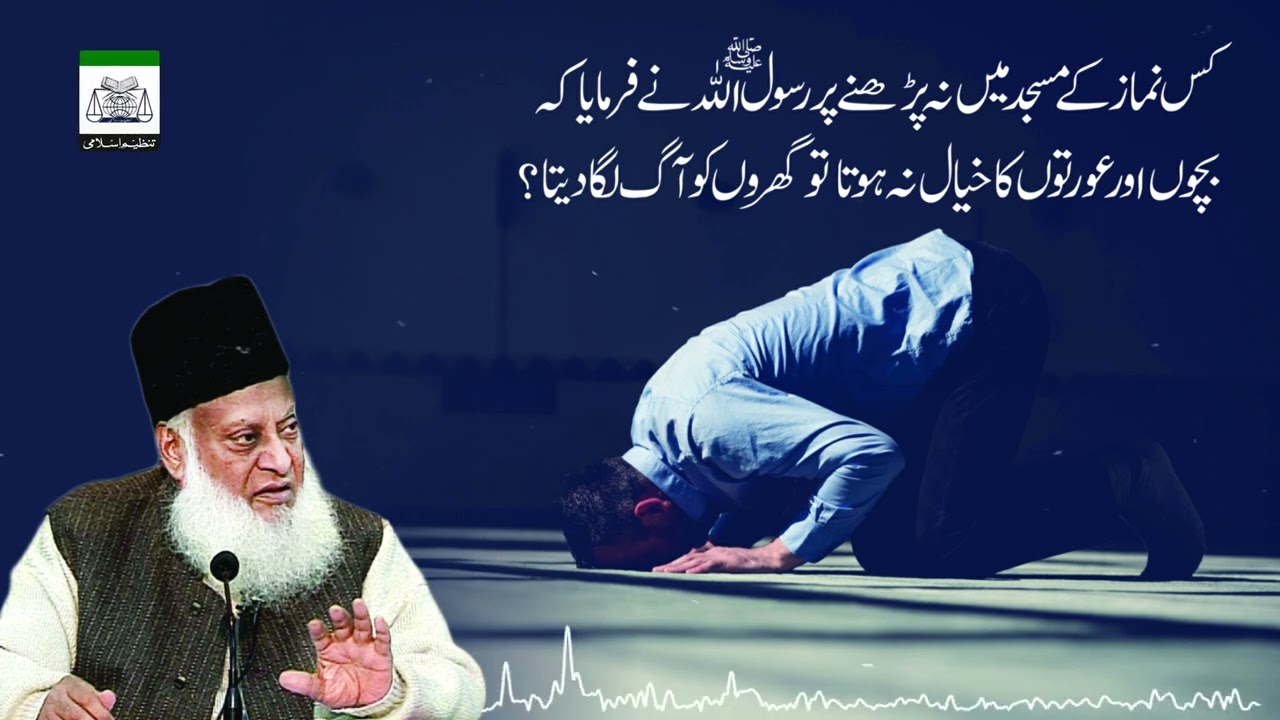
In this clip Dr Israr Ahmed explains a hadith where the Prophet (SAW) warned against praying at home instead of the mosque. The user believes this refers to Fajr prayer, as it is hardest for hypocrites, not Jumu’ah, which must be prayed in the mosque. Jumu’ah exemptions apply to travelers, the sick, and slaves, but regular prayers like Fajr stress mosque attendance for men.