Top videos

In this clip, Dr Israr Ahmed explains how Islam's entry into Europe in the early ages transformed a dark and repressive era, particularly in Spain, fostering a culture of learning and tolerance. This laid the foundation for later advancements in science and philosophy, notably in England, where resistance against religious authority led to a more secular society focused on scholarship, economic freedom, and social liberalism.

Dr. Israr Ahmed talks about believing in one God (Tawheed) and its importance. He stresses faith in Allah, the afterlife, and the Prophets, which has been consistent from Adam to Prophet Muhammad (S.A.W) The main idea is that there's only one Allah who created and controls everything, and one day, He will end the world and judge everyone. The Quran mentions Allah's role in creating and gathering the universe. Dr. Israr Ahmed emphasizes that faith in Allah is central to Tawheed.

" In this video Dr. Israr Ahmed explain that Quran and science go together. Quran is God's word, and nature is God's creation. They don't contradict each other. Quran mentions things that were unknown 1400 years ago, but science has since proven them true."

In this clip Dr Israr Ahmed says that Pakistanis' failure to uphold Allah's law after gaining independence has led to hypocrisy, affecting future generations. He explains that, like the Israelites in the Quran, later generations are responsible for following the same wrong path. He urges youth to dedicate themselves to their religious rights, just as they do for worldly causes.

Dr. Israr Ahmed distinguishes between "fail" (what happens, planned or not) and "amaal" (purposeful actions). Amaal means doing things with a goal, like working hard. Amaan is when actions are good and help people become better. Those who do good regain their true purpose, while those who act without thought are like animals. The clip also mentions basic human goodness and following divine rules.

In this clip, Dr. Israr Ahmed discusses the benefits of holding fear and piety for Allah. He explains that by nurturing these qualities, our hearts guide us towards what's right and wrong. Trusting our hearts' judgments and seeking forgiveness from Allah, who is Most Gracious, ensures our spiritual growth.
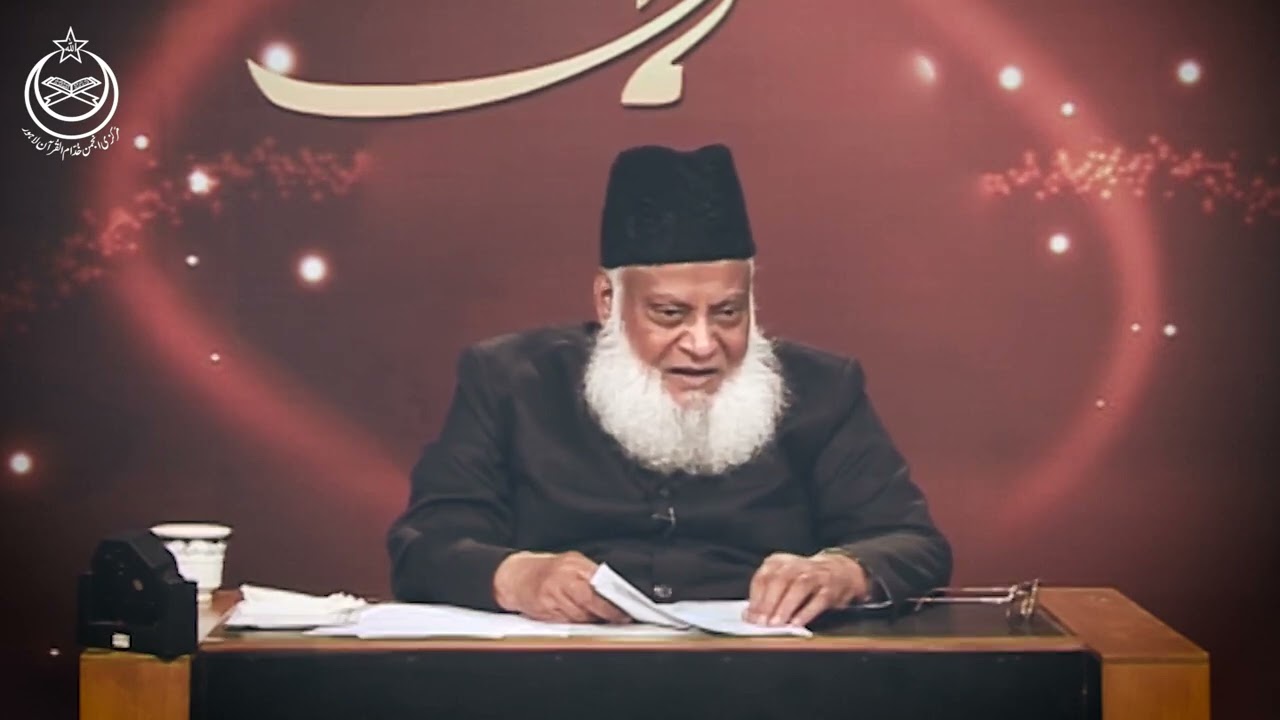
In this clip, Dr Israr Ahmed explains that Allah's help can come in various forms and at any time. He emphasizes the importance of having faith in Allah and not losing hope in His mercy. He gives examples from history, like the Battle of Badr, where angels aided the believers. However, he highlights that Allah tests people before granting help and that sincere faith and righteous conduct precede divine assistance.

In this clip Dr Israr Ahmed explains that Jihad is striving for Allah’s cause, while Qital involves combat and killing. In Makkah, the Prophet (PBUH) did peaceful Jihad, and Qital began in Madinah. The Kashmir struggle is Jihad-e-Azadi, a valid effort for freedom. Those who die in it achieve Shahadat (martyrdom).

In this clip Dr Israr Ahmed explains that the best form of hijrat (migration) is to give up anything that displeases Allah. He encourages people to immediately stop engaging in things like interest (sood) and to follow Islamic teachings, such as modesty, at home. The highest level of hijrat is when someone leaves everything, even their family, to fight for the establishment of Islam during difficult times.

In the video, Dr. Israr Ahmed talks about the tough tests people go through, as mentioned in Surah Al-Ahzab. He highlights how humans have taken on responsibilities like caliphate, making their trials harder.

The Economic and Financial System Of Islam | Dr Israr Ahmed Full Bayan

In this clip Dr Israr Ahmed discusses how every action has a purpose, leading to either positive or negative outcomes. Despite this, people often engage in wrongful activities like cheating and drug dealing. He emphasizes that while good deeds should be rewarded and bad deeds punished, ultimately, it's up to God to decide each person's fate.

Shia Sunni Ikhtilaf | Reality Behind Shia Sunni Riots | Dr Israr Ahmed Prediction About Muslim World
Shia Sunni Ikhtilaf | Reality Behind Shia Sunni Riots | Dr Israr Ahmed Prediction About Muslim World

In this clip Dr Israr Ahmed explains that hypocrisy (nifaq) develops when someone loves wealth and the world too much. To prevent or cure it, he advises giving generously in the way of Allah. By doing this, a person can weaken the hold of materialism on their heart. If not addressed, hypocrisy can lead to a rejection of truth and opposition to sincere believers. The best way to overcome this is to keep spending and remain mindful of Allah.

In this clip, Dr Israr Ahmed emphasizes the importance of perseverance in the path of Allah, urging believers never to lose hope. He quotes from the Quran, stating that trials are inevitable but one must continue striving. Using examples from Islamic history, he illustrates the significance of resilience and unwavering faith in overcoming challenges. The message underscores the idea of trusting in Allah's plan and remaining steadfast in the face of adversity.

In this clip Dr Israr Ahmed stresses gratitude to Allah for His guidance, emphasizing it's all by His grace. He highlights stages of guidance: initiation, progression, and reaching the destination. Gratitude, he says, means recognizing all abilities are from Allah, shunning arrogance. He urges adhering to Allah's path, focusing on responsibilities without pride.

In this clip, Dr. Israr Ahmed explains that the Quran is perfectly preserved and widely recognized as the book given by Prophet Muhammad (SAW). He highlights that the Quran's text is authentic and unchanged. Dr. Israr Ahmed clarifies that Hazrat Usman (RA) prepared an official copy for consistency, and the Quran was divinely compiled.

In this clip Dr Israr Ahmed discusses how prophethood is linked to certainty (yaqeen). He explains that the Prophet Muhammad (SAW) sought certainty and was born with the potential for faith. This potential is revealed through divine revelation, making the Quran a guiding light for humanity, helping them understand faith and God.
In this clip Dr Israr Ahmed talks about how life has five stages, similar to a plant's growth. He says each stage is important, from being a baby to growing up. He compares human life to how plants grow from seeds to crops, showing how life has its own natural rhythm.

In this clip Dr Israr Ahmed explains why it's not okay to ask for help from Hazrat Ali (RA) or Sheikh Abdul Qadir Jilani. He says it's not right to call upon them for assistance in Islam. Instead, Muslims should only ask for help from Allah. He explains that asking anyone besides Allah for help is considered shirk, which means associating partners with Allah.