Top videos

In this clip Dr Israr Ahmed says we should control our thoughts and desires, and obey Allah above all. He warns not to blindly follow others, but to respect parents and teachers within Islamic limits. The Quran says we shouldn't prioritize desires over Allah's commands or do interest-based transactions. Instead, we should follow Allah's guidance and resist bad urges.
In this clip Dr Israr Ahmed explains that Hazrat Abu Zar Ghafari was asked to leave Madina for preaching that keeping gold and silver without spending it for Allah’s cause is forbidden, based on a Quranic warning about unused wealth becoming a punishment. However, Islam allows lawful wealth if zakat is paid, permitting private ownership and halal earnings, while prohibiting income from haram sources.

Dr Israr Ahmed Full Bayan On Iqamat E Deen | ibadat kya hai | Dr Israr Ahmed Official
In this clip Dr Israr Ahmed describes true Muslims as those whose hearts tremble at Allah's mention, who deepen their faith upon hearing His verses, and who pray and give charity. He highlights the Muhajireen who migrated for Allah, underwent rigorous training, and shared everything, forming a strong bond. The true helpers were the migrants, backed by a 13-year history.

In this clip Dr Israr Ahmed says that ulema (Islamic scholars) inherit the spiritual knowledge of prophets, like the Quran and Sunnah, not material wealth. Their main role is to spread these teachings. However, he disagrees with the idea that only ulema should rule, as governance in Islam isn't limited to scholars. Instead, leading the community is a shared responsibility, not a theocracy run by a single group.

In this clip Dr Israr Ahmed explains that true faith requires actively fighting against oppressive systems (taghoot). Simply doing religious acts like praying and fasting isn't enough; you must work to oppose injustice. He stresses the importance of attending Friday prayers (Jumaat) and warns against making excuses. Muslims should look for genuine communities committed to establishing Islamic principles.

Dr. Israr Ahmed highlights the significance of Surah Asar, the Quran's shortest and earliest chapter, serving as a comprehensive index of its themes. The companions would listen to it before parting ways, emphasizing reflection. Dr. Israr suggests that focusing on Surah Asar is sufficient for guidance, even if it were the only revelation. The surah encapsulates principles of good deeds, adherence to Shariah, and basic human morality.

In this clip Dr Israr Ahmed emphasizes that a wali (friend of Allah) is characterized by strong faith and adherence to Islamic teachings. According to him, Allah loves and protects believers, and their love for Allah deepens over time, beginning with declaring faith (Shahada). Hostility towards Allah's wali is cautioned against. Importantly, being a wali is centered on deep faith rather than performing miracles.

In this clip Dr Israr Ahmed discusses "azeem shirk," highlighting it as one of the greatest forms of shirk where human authority is elevated above Allah's. He emphasizes the importance of recognizing Allah's sovereignty and following His guidance, rather than claiming legislative power contrary to His commands.
Dr. Israr Ahmed discusses a saying of the Holy Prophet (PBUH) about spreading good deeds to fellow believers. He narrates a hadith about an incident between Prophet Muhammad (PBUH) and Hazrat Gabriel (A.S), where Allah commanded the Prophet (PBUH) through revelation.
Latest Technology + Western Civilization مغربی تہزیب Dr Israr Ahmed Official

Dr. Israr Ahmed emphasizes the importance of faith in the Hereafter, stating it as the cornerstone of belief. He explains that belief in the Day of Judgment influences actions, and lack of it can lead to sinful behavior. Additionally, he discusses the five aspects of faith given by Allah for accountability in this life and the Hereafter.

In this clip Dr Israr Ahmed warns against working in banks and dealing with interest, which is forbidden in Islam. Even though multinational companies may engage in interest-based transactions, it's best to avoid such activities, especially in underdeveloped countries where the impact can be severe.

In this clip Dr Israr Ahmed explains that while Western countries like the U.S. and the UK don't oppose Islam as a religion, they are against the idea of Islam's political and social system gaining influence. They allow Muslims to practice their faith, but they won't accept an Islamic system replacing their own. Dr. Israr stresses that Muslims should work towards establishing Islam's principles in society, especially if they have the power to do so.

In this clip Dr Israr Ahmed explains that women are allowed to pray in mosques, but it's better for them to pray at home according to Islamic teachings. Praying in a private space at home is considered more virtuous. However, there is no strict rule stopping women from praying in mosques.

In this clip Dr Israr Ahmed explains that his organization has not yet reached its goal in rural areas, but believes change is still achievable. He compares their struggle to the long efforts of past prophets, like Prophet Noah. Despite challenges, their work is growing in rural regions such as Punjab and Sindh. He emphasizes that true revolutions are driven by dedication and effort, not elections. Dr. Ahmed Israr stresses that real change comes from hard work, not just political votes.
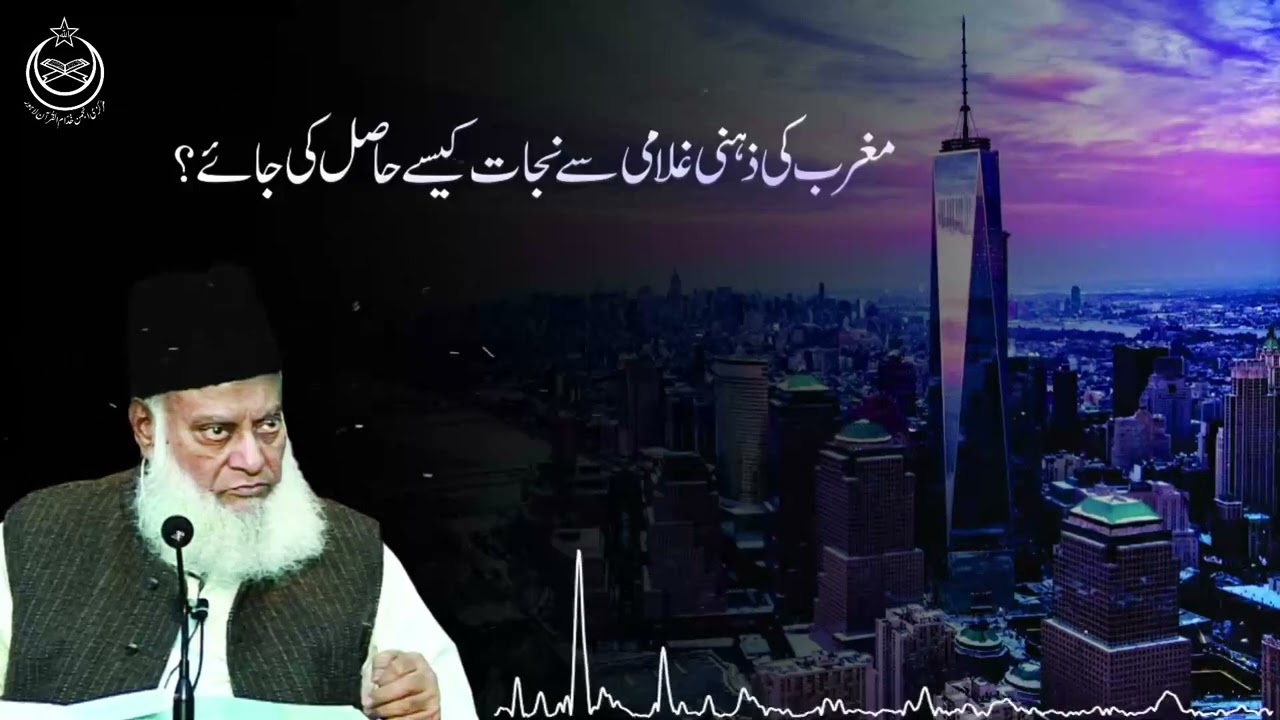
In this clip Dr Israr Ahmed highlights that while Muslims have gained political freedom, they remain mentally influenced by the West. To break this, he suggests studying and presenting Islamic teachings, especially on topics like politics, at a high academic level. This will help show that Islam offers its own solutions and guidance, reducing reliance on Western ideas.

In this clip Dr Israr Ahmed talks about debates between Muslim scholars and missionaries. In India, a German missionary named Paderi Fander troubled Muslims until locals stood up to him. He debated Islamic scholars but changed his tone when he lost. "Munazera" isn't in the Quran; it's about winning with wisdom and strength.

In this clip Dr Israr Ahmed explains that hand-drawn pictures and statues are clearly forbidden in Islam, based on Hadith. The invention of the camera led to scholarly debate, with most agreeing that photography, involving no manual creation, is permissible. Some Indian scholars initially opposed it but allowed its use for identification and legal purposes. Extending this reasoning, Dr. Israr permits videos for religious education, as videos are moving images, not static pictures.

Behtareen Insan Kon Hen? | Life Changing Advice From The Prophet ﷺ For Ummah | Dr. Israr Ahmed Bayan
In this clip Dr israr ahmed explaining that the best person is the one who learns and teaches the Quran.Bahtreen shaks kon ha?bahtreen shaks woh ha jo Quran seekhy aur byaan kray.Quran 1400 saal phaly utra.The solution to all the problems that man has till the Day of Resurrection is in the Quran.Dig into the Quran and find guidance in it.Quran ko khood kar iski gahrai ma utro aur hidayat nikalo.aik khutby ma hazoor (SAW) ny logo se pocha k bato k mane Quran ka kalaam tum sab tak poncha dya ha k nahi is pa pory majmein ny kaha han Hazoor (SAW) hum gawahi dety hain k apne amanat ka haq,rasalat ka haq,fraiz ka haq aur khair khwahi ka haq ada kar dya ha .Hazoor (SAW) apne gumrahi aur andherion k pardo ko chaak kar dya.The Holy Prophet (PBUH) closed the veils of misguidance and closed the darkness.The Holy Prophet (PBUH) looked at the sky and said,"O Allah, bear witness that i have conveyed the Quran to them."kash humain maloom hota k Quran seekhna aur seekhana kitna ala career ha.kash humain maloom hota k Quran ki tableegh aur dawat ma guzra her lamha kitna keemati ha.Muhammad (SAW) ny farmaya ay allah mane ye boj apne kandoin se utar dya ha aur logo tak poncha dya ha ap abhi gawah hain.aur unho ny umat-e-Muhammad (SAW) se kaha k ab ye Quran tum log buhaat zamadari se logo tak ponchao aur mera koi umati farigh na rahy aik ayat bhi poncha sakty ho tu ponchao kio k jis ny Quran seekha aur seekhaya wo tum ma se sab se bahter ha.