Top videos

In this clip Dr Israr Ahmed explaining that Allah ke rasool ny 3 dafa qasam khai k woh shakhs momin nahi hosakta aur sahib-e-iman nahi hosakta jis ki wajah se us k padhosi ki eyza rasai ho.A person cannot be a momin and sahib-e-iman whose neighbor is not peace because of his misbehavior,immorality,and lack of access.Ans Ibn Malik admired the morals of the Holy Prophet (PBUH) .Whenever the holy Prophet (PBUH) used to deliver sermons,he used to say :"he who dose not have honesty dose not have faith;he who does not have loyalty does not have religion."

In this clip Dr Israr Ahmed is saying that love for Allah, His Messenger, and striving in His cause should be greater than any worldly love, like love for family, wealth, or possessions. If these worldly loves are stronger, then one is not truly devoted to Allah and won't find guidance or true connection with Him.

In this clip, Dr. Israr Ahmed explains "shirk fil muhabbat," where love for anything surpasses love for Allah, highlighting Quranic comparisons of love. He emphasizes the necessity of prioritizing love for Allah over all else, referencing a verse from Surah Tawbah.
In this clip Dr Israr Ahmed explains that in matters where Islamic scholars (Imams) differ, only knowledgeable individuals with a deep understanding of the Qur'an, Sunnah, and Shariah should decide. The opinion closest to the Qur'an and the Prophet's teachings is preferred. However, an easier option may be accepted if it stays within Shariah guidelines.
The speaker talks about following God's rules instead of our own desires, using Dr. Israr Ahmed's ideas. They warn that putting ourselves first, like Pharaoh did, can be dangerous. They say we should choose what's right by following God's commands, not just what we want.

In this clip Dr Israr Ahmed discusses the challenges of promoting Islam, especially for poor people. He asks if those who can only give a little time are fulfilling their religious duties. He highlights the importance of self-assessment: how you see yourself, how others see you, and how Allah sees you. He also emphasizes that Allah doesn’t give anyone more responsibility than they can handle and encourages people to contribute to Islam if they can improve their lives.

In this clip Dr Israr Ahmed discusses the importance of Surah Rahman, which the Prophet Muhammad (PBUH) called the "Bride of the Quran" for its beauty. He shares that Allah loves to listen to the Quran and praises beautiful recitation. The names "Rahman" and "Raheem" highlight Allah's immense and continuous mercy. The key takeaway is the significance of reciting the Quran thoughtfully and appreciating Allah's mercy.

In this clip Dr Israr Ahmed talks about the situation in 2003, focusing on Iraq and the Middle East. He says that the solution to the problems faced by Muslims is collective repentance (tubah). He believes the ongoing events are part of a plan to change the Middle East, similar to how it was divided after World War I. This plan, he says, aims to create a "Greater Israel," and the war in Iraq is a step towards that.
In this clip Dr Israr Ahmed explains that people from different Islamic sects, including Jaferi (Shia), can join Tanzeem-e-Islami if they respect the Sahaba and the rightly-guided caliphs. He emphasizes unity on core Islamic beliefs while allowing diversity in sects. Sectarian differences like Barelvi and Deobandi are seen as cultural, not fundamental. True religious guidance, he says, should come from authentic Islamic teachings, not dreams or visions.

In this clip Dr Israr Ahmed explains Surah Zilzal, which describes the Day of Judgment. The earth will shake, revealing our secrets, and we'll be held accountable for our actions. The surah is like a witness against us, reminding us to be mindful of our deeds and prepare for Judgment Day."

In this clip Dr Israr Ahmed explains the end-times events, like Dajjal's emergence, Prophet Isa’s (A.S.) return, and a major war, with uncertain timing but possibly within 100-200 years. He links these to Muslim history’s rise and fall and sees signs of revival despite current decline. The gathering of Jews in Israel is highlighted as a key sign. Future wars are expected to shape these events.

In this clip Dr Israr Ahmed explains that Masjid al-Aqsa, originally the Temple of Solomon, was destroyed and rebuilt multiple times before its ruin by the Romans in 70 CE. During Prophet Muhammad’s (PBUH) Miraj, the site had no major structure. Hazrat Umar later prayed nearby and cleaned the area. Caliph Abdul Malik built the Dome of the Rock over a sacred stone, while Masjid al-Aqsa lies to its south.

In the video Dr Israr Ahmed predicted China's rise as a superpower and advises Pakistan to quickly form alliances. He emphasizes China's strength against pressure and suggests aligning with it strategically. Dr. Israr Ahmed highlights divine support for this alliance and the importance of timely decisions. He recalls Pakistan's past defense pact with India and suggests seeking divine help for current challenges. Ahmed stresses divine intervention and human effort in overcoming obstacles.

In this clip Dr Israr Ahmed says death is sure to happen, and what we get from Allah isn't just money. Even if we promise to give money when we're dying, it won't change anything because Allah decides when we die. He warns against being too focused on money and worldly things, even if we live longer.
In this clip Dr Israr Ahmed explains why life brings us challenges. He says all human beings irrespective of their social and financial status, and achievements face tough times, even those who can't afford basic necessities. The Quran teaches us that these struggles are part of being human, be it physical or mental struggle.

In this clip Dr Israr Ahmed discusses finding inner peace through "ziker" (remembrance), which includes reading the Quran and saying special prayers. By doing these things, we feel closer to Allah and improve our relationships with others. He emphasizes the importance of these practices in nurturing spiritual well-being.
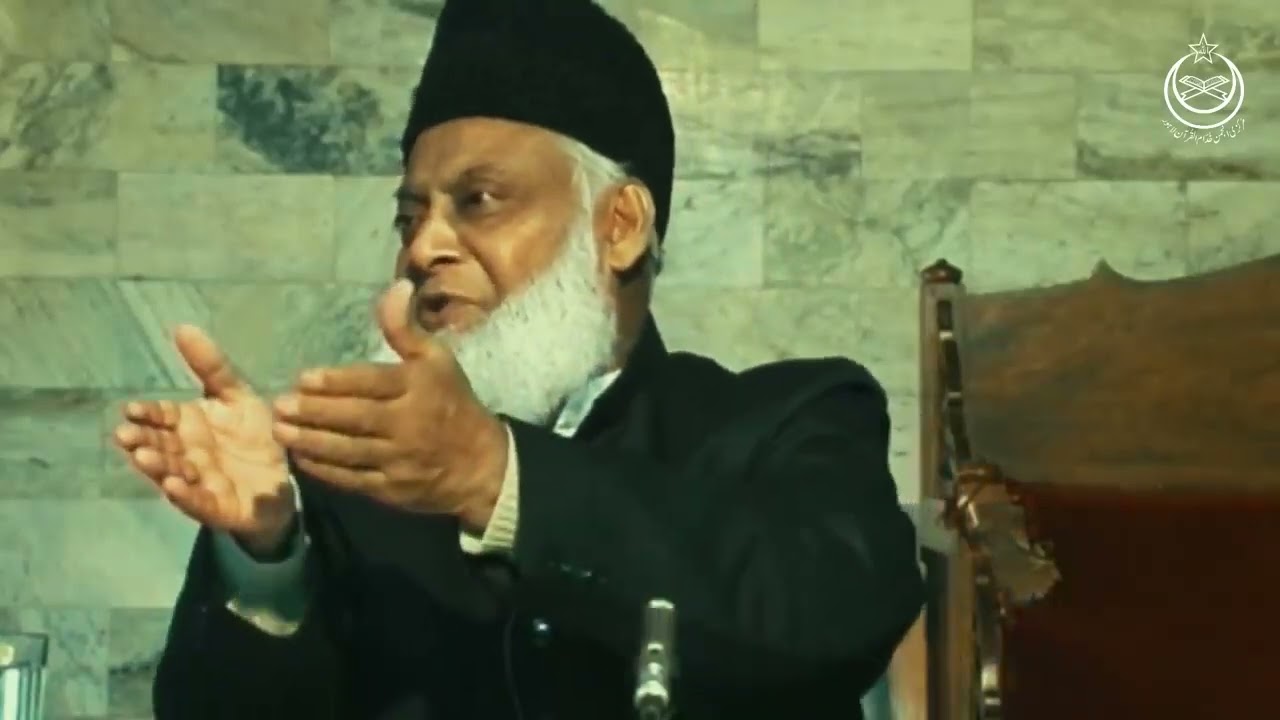
In this clip Dr Israr Ahmed talks about unfair wedding traditions and says we should stop putting pressure on the bride's family. He believes marriage should be fair and both partners should share responsibilities. He thinks dowry shouldn't be seen as buying someone. Keeping weddings simple is better, according to him, and it matches Islamic beliefs.

In this clip Dr Israr Ahmed explains that Quran recitation should not be just an art form but should come from the heart. He emphasizes the importance of learning proper pronunciation and tajweed (recitation rules) to avoid altering the meanings of words. Even knowledgeable Imams may not be expert reciters, so it's important to learn from qualified teachers.

In this clip Dr Israr Ahmed says real success isn't just about money or power. It's about believing in the right things, doing good, staying strong, and being patient. Success isn't only for rich or powerful people. Even those with nothing, like Abu Zerzifari, can be successful through faith and doing what's right.

In this clip Dr Israr Ahmed discusses the two main aspects of jihad in Islam: personal worship (ibadah) and spreading Islam. He explains that some Islamic laws can't be implemented in non-Islamic countries due to the lack of an Islamic system. He emphasizes the importance of following Islamic guidelines wherever possible. Dr. Israr Ahmed also outlines how to choose Islamic groups based on their goals, leadership, and methods.