Top videos

Khilafat Kya Hai | خلافت کیا ہے ؟ | Presidential System VS Parliamentary | Dr Israr Ahmad Bayan

In this clip Dr Israr Ahmed explains that Jihad is striving for Allah’s cause, while Qital involves combat and killing. In Makkah, the Prophet (PBUH) did peaceful Jihad, and Qital began in Madinah. The Kashmir struggle is Jihad-e-Azadi, a valid effort for freedom. Those who die in it achieve Shahadat (martyrdom).

In this clip Dr Israr Ahmed explains the meaning of hypocrisy (nifaq) in Islam. He compares it to a secret tunnel or an animal’s burrow with multiple exits, used to escape danger. A hypocrite is someone who pretends to be different things to different people, saying one thing to one group and something else to another, just to protect themselves. This double-faced behavior is the essence of hypocrisy.

In this clip Dr Israr Ahmed explains that, in Islam, a woman’s main role is to care for her family, while the husband provides financially. Women can work if they follow Islamic guidelines, like wearing hijab. He suggests women-only workplaces, like hospitals and schools, to keep things modest and aligned with Islamic values.

Dr. Israr Ahmed explains how Hazrat Musa's mother followed Allah's command, leading to him being raised by Pharaoh's wife, Asiya. Despite Pharaoh's intent to harm him, Asiya insisted on adopting Musa. According to the Torah, Musa's brother abandoned him in the desert with a hateful command to prophesy among snakes

In this clip Dr Israr Ahmed explains an Allama Iqbal poem where Shaitan talks to his followers about how he has spread greed and false beliefs, making people stray from true faith. Shaitan's system is strong, and Muslims have become focused on worldly things instead of their true spiritual path. Shaitan only fears Muslims who truly follow the Quran.
Dr. Israr Ahmed talks about having true faith in Allah and His Messenger (S.A.W). He says it's not enough to just pray or read the Quran; we must sincerely believe in our hearts and follow Allah's guidance. He warns against pretending to be faithful while holding resentment inside.

In this clip Dr Israr Ahmed teaches that regular remembrance of Allah (zikr) is crucial for spiritual well-being. A spiritual guide can help diagnose and treat spiritual issues like a doctor does for physical health. Consistent zikr, including prayers and Quran recitation, strengthens the heart and prevents spiritual weaknesses. This practice guards against hypocrisy and negative influences.

In this clip Dr Israr Ahmed discusses the concept of intercession (Shafa'at) in Islam, explaining that it is a complex issue. He mentions that while the Quran denies certain types of intercession, it also allows intercession for those whom Allah grants permission. Intercession is not about someone having the power to act on their own but requires divine approval. Dr. Israr emphasizes that the idea of intercession should be understood correctly and that it is only valid if Allah permits it.
In this clip Dr Israr Ahmed explains a hadith where the Prophet (SAW) warned against praying at home instead of the mosque. The user believes this refers to Fajr prayer, as it is hardest for hypocrites, not Jumu’ah, which must be prayed in the mosque. Jumu’ah exemptions apply to travelers, the sick, and slaves, but regular prayers like Fajr stress mosque attendance for men.
In this clip Dr Israr Ahmed explains that for Muslims, character is closely linked to religion. However, non-Muslims can also have good character. He points out that some people may follow religious practices but lack integrity, while others may not be very religious but still have strong character. Both good character and religious practices are important.
In this clip Dr Israr Ahmed discusses the time of Hazrat Abu Bakr's caliphate, where people longed to escape accountability before Allah. With no central government in Arabia, taxation was absent, and society was divided into tribes. Some embraced Islam, while others rebelled after the Prophet's passing, leading to a tumultuous period.

In this video, Dr. Israr Ahmed explains how to ask Allah for help correctly. He emphasizes that we should only pray to Allah and not to anyone else. Dr. Israr also discusses some of the conditions Allah expects from His servants.
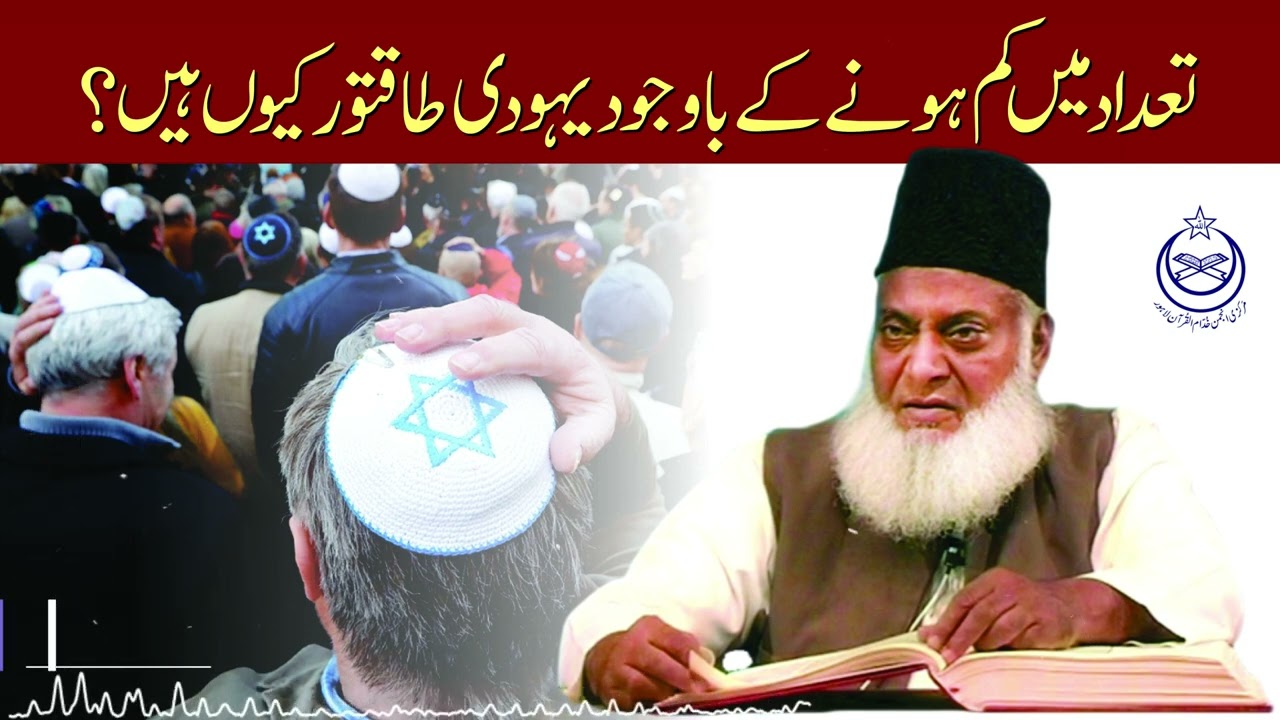
In this clip Dr Israr Ahmed explains why Jews are powerful despite being fewer in number than Muslims, who have the Quran and Sunnah. He says Jews are smart, organized, and work together well. Being a minority makes them active and focused, while larger groups can become passive. Jews have a strong identity and nationalism, allowing them to recover from setbacks. In comparison, Muslims are diverse, which can make it harder for them to unite.

Is this clip, Dr Israr Ahmed highlighted Prophet Muhammad's (pbuh) unwavering dedication to spreading Islam as depicted in the Quran, comparing his efforts to previous prophets. He emphasized how Prophet Muhammad's mission resulted in the triumph of Islam across Arabia, showing his role as a messenger for all humanity, offering both guidance and warning.

In this clip Dr Israr Ahmed explains that if a wife admits to zina (adultery) and repents, the husband should forgive her, as repentance can erase the sin. If the husband wants to punish her, both must swear oaths to confirm the truth. The husband must swear four times, and the wife can also swear to deny the accusation. If both are truthful in their oaths, the wife avoids punishment. The situation should be handled with fairness, privacy, and according to Islamic guidelines.

In this clip, Dr Israr Ahmed explains why Prophet Muhammad didn't attack Makkah. He avoided fighting near the sacred mosque to keep it safe. His goal was to end idol worship peacefully and establish belief in one God. The Prophet's actions aimed to peacefully convince the Quraysh to leave Makkah and preserve its sanctity.

In this clip Dr Israr Ahmed explains that healing is ultimately from Allah, whether through medicine or other means. Using taveez or jhad phoonk is permissible if done correctly, without un-Islamic practices. Muslims should place complete trust in Allah, not in these practices. Seeking medical treatment is fine, but always remember that Allah is the true healer.

In this clip Dr Israr Ahmed explains that Shirk-e-Khafi, or hidden shirk, happens when someone does good deeds like praying, fasting, or giving charity to show off to others instead of doing it sincerely for Allah. He emphasizes that even small actions done for attention can be considered hidden shirk, which is hard to notice but very serious. To avoid this, he advises being sincere and doing everything purely for the sake of Allah.

In this clip Dr Israr Ahmed explains that for salvation through the Quran, you need belief, good deeds, truth, and patience. All four are essential. Understanding the Quran has two levels: basic lessons and deeper reflection. Basic lessons are straightforward, while deeper reflection reveals more insights.