ویدیوهای برتر

In this clip Dr Israr Ahmed explains that all prophets shared the same religion, but their laws varied. Muslims follow the laws of Prophet Muhammad (SAW). He highlights the importance of understanding the Prophet's methods (Manhaj) for reform. By studying the Prophet's life (Seerah), we can learn how to implement change step by step. This approach is essential for the community's improvement today.

In this clip Dr Israr Ahmed explains that Nikah (marriage) in Islam is a contract between a man and a woman. The bride gives her consent through a guardian in front of witnesses, while the groom is present. He emphasizes that Nikah should be announced publicly, ideally in mosques. Dr. Israr also recited a Nikah in the video and prayed for blessings, love, and righteous children for the couple.

In this clip, Dr. Israr Ahmed explains the differences in Islamic views on three divorces (talaq). He says that during the waiting period (iddah), the husband must support his ex-wife. In the four Sunni schools, giving three divorces at once is usually counted as one, but the Shia believe it counts as one divorce. He also notes that two witnesses are needed for a valid divorce.
In this clip Dr Israr Ahmed highlights the importance of women in religious organizations, stressing that it doesn’t mean breaking Islamic rules. Men and women have different roles but can both attain spiritual heights. Women can do important work at home, while men pray in mosques. The Prophet Muhammad (SAW) assured a woman that caring for home and children brings rewards similar to those of fighters in battles.

In this clip Dr Israr Ahmed explains that Western society’s freedom from boundaries between relatives and non-relatives comes from a materialistic view that denies the soul and focuses only on the body. This view reduces humans to animals, ignoring their spiritual essence. Islam, however, teaches that humans are spiritual beings connected to God, and this loss of spirituality in the West is the root cause of moral and social problems.
In this clip Dr Israr Ahmed explains that in the early days of Islam (Makki period), Tahajjud was the only prayer, but it wasn’t mandatory. As time passed, the rules around it changed, becoming less strict. Different scholars mention different timings for when these changes happened, but it’s agreed that the command became more flexible, especially after the migration to Madinah.
In this clip Dr Israr Ahmed highlights that in Pakistan, many religious scholars approach their roles as jobs, prioritizing power and control over their true duty of guiding people. According to him, their real responsibility, as outlined in the Quran, is to promote goodness, prevent wrongdoings, and lead people toward the right path. However, many scholars neglect this duty out of fear of losing followers or support.

In this clip Dr Israr Ahmed discusses the two main aspects of jihad in Islam: personal worship (ibadah) and spreading Islam. He explains that some Islamic laws can't be implemented in non-Islamic countries due to the lack of an Islamic system. He emphasizes the importance of following Islamic guidelines wherever possible. Dr. Israr Ahmed also outlines how to choose Islamic groups based on their goals, leadership, and methods.

In this clip Dr Israr Ahmed explains that in an Islamic government, opposition is allowed if it follows Shariah. The caliphate isn’t a one-party system but lets people choose between different programs. Parties must stay true to their promises. In a presidential system, decisions are based on honesty, not party influence. Islamic governance balances religion with modern needs.

In this clip Dr Israr Ahmed explains that mentioning the Rightly Guided Caliphs (Khulafaye Rashideen) in Jumu'ah khutbahs is a matter of personal preference. Some believe only Quran and Hadith should be discussed, while others include the Caliphs' names. Dr. Israr Ahmed personally mentions their virtues, as described in Hadith, to highlight their importance in Islam.

In this clip Dr Israr Ahmed explains that conflicts among the Sahabah escalated due to propaganda and chaos, making it hard to determine who was right. Despite efforts for peace, the situation was too complex to resolve. He highlights that external manipulation fueled the disputes and critiques some historical analyses for ignoring these deeper causes.

In this clip Dr Israr Ahmed explains that his organization has not yet reached its goal in rural areas, but believes change is still achievable. He compares their struggle to the long efforts of past prophets, like Prophet Noah. Despite challenges, their work is growing in rural regions such as Punjab and Sindh. He emphasizes that true revolutions are driven by dedication and effort, not elections. Dr. Ahmed Israr stresses that real change comes from hard work, not just political votes.
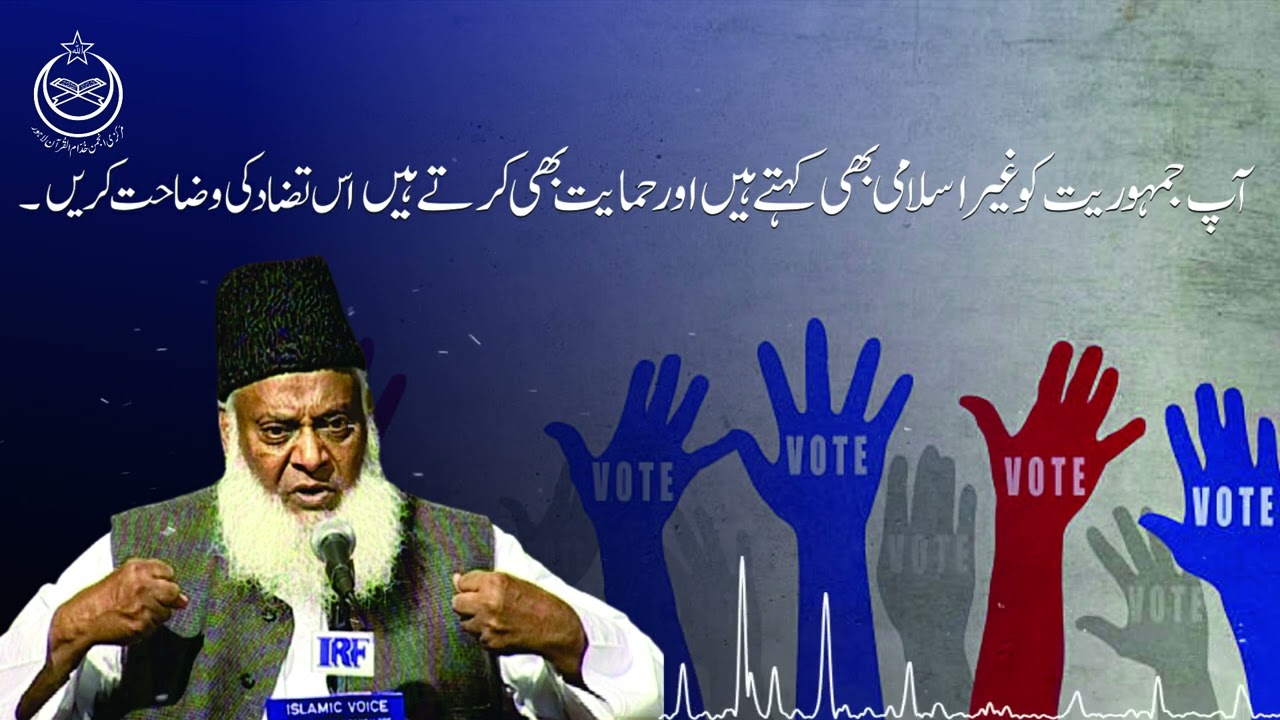
In this clip Dr Israr Ahmed explains that democracy is not an Islamic system because sovereignty belongs only to Allah. However, he considers it better than martial law for Pakistan as a temporary solution. He believes an Islamic system can only be established through revolution, not through democracy. This is because democracy gives equal weight to all votes, regardless of a person’s righteousness or morality.

In this clip Dr Israr Ahmed explains that calling Islamic movements a "failure" is wrong. He compares it to the Prophet Muhammad’s struggles in Makkah, which seemed unsuccessful but were part of a bigger plan. Establishing Islam takes time and happens over generations. Every sincere effort counts, is rewarded by Allah, and contributes to the ongoing growth of Islam.

In this clip Dr Israr Ahmed explains that loving your homeland is natural and allowed in Islam, but it should not be more important than love for Allah, His Messenger, and following Islamic teachings. Islam does not support nationalism that prioritizes the country over religion. Loving your homeland is fine, but faith and obedience to Allah must come first.

In this clip Dr Israr Ahmed questions whether banks should be closed due to their involvement in interest (sood). He suggests replacing them with investment corporations that share profits and losses, making the system halal. He believes this change is achievable through a revolution that builds awareness and leadership. This would create a fairer financial system without interest.

In this clip Dr Israr Ahmed explains that Islam allows taking captives only during legitimate wars (Jihad), not by forcefully capturing free people, which is strictly forbidden. Prisoners of war (POWs) can be integrated into society instead of being confined to camps. Relations with such captives are permitted without marriage, but freeing and marrying them is encouraged as a noble act. Selling captives was allowed historically under strict rules but is not applicable today. Forced slavery is strictly prohibited in Islam.

In this clip Dr Israr Ahmed talks about the importance of modesty in Islam, especially for women. He explains that women should cover their bodies, leaving only their face, hands, and feet visible, and this should be kept private from men, except for their husband or a doctor when necessary. He emphasizes the need for modesty in both men and women and acknowledges that following these rules can be difficult in today's world but is essential for preserving Islamic values.

In this clip Dr Israr Ahmed explains that using "waseela" in dua is permissible if it aligns with Islamic teachings, such as invoking a righteous deed or pious person for intercession. Dua is a direct connection with Allah, but intercession can be valid in specific cases. Allah answers prayers in three ways: granting the request, offering something better, or using it for spiritual benefit. Allah's response is always guided by His wisdom.