En iyi videolar

In this clip Dr Israr Ahmed explains that establishing Khilafat is our responsibility, but it must be adapted to the modern world. The core principles of Khilafat remain the same, but their implementation needs to fit current conditions. He stresses the importance of following Islamic rules while adapting them to today's context. Historical efforts are acknowledged, and he highlights the need for ongoing discussion on practical applications.

In this clip Dr Israr Ahmed explains the debate on whether good deeds are part of faith. Imam Abu Hanifa says actions are separate from faith and don't affect it. Imam Bukhari believes faith includes both belief and actions, which can increase or decrease. Imam Abu Hanifa views faith legally, meaning even if someone sins, their faith remains, but they are punished for the sin separately.

In this video, Dr. Israr Ahmed shares five concise pieces of advice from Hazrat Luqman (RA) to his son: 1. Avoid associating partners with Allah. 2. Actions, no matter how small, will be rewarded. 3. Maintain regular prayer. 4. Promote good and discourage evil. 5. Practice patience always.

In this clip Dr Israr Ahmed teaches how to ask Allah for forgiveness and which kinds of repentance are accepted. He tells a story about a man who loses his camel in the desert but finds it again, showing how Allah rejoices when someone sincerely repents. Dr. Israr Ahmed stresses the need to repent promptly for mistakes, whether accidental or due to strong emotions. Allah forgives those who sincerely seek forgiveness, demonstrating His mercy and readiness to forgive.

In this clip Dr Israr Ahmed explains how to repent according to Quran and Hadith. He emphasizes Allah's readiness to accept repentance and Prophet Muhammad's teaching that everyone makes mistakes, but sincere repentance is commendable. True repentance involves stopping the wrongdoing, feeling remorse, and continuously seeking forgiveness, even if mistakes recur. He also warns against despair, comparing it to following Satan's path.

In this clip Dr Israr Ahmed explains that before coming to this world, our souls lived in a different realm called Alam-e-Arwah. There, all souls were created and made a promise to recognize Allah as their Lord. Our souls were fully aware and conscious, even though we didn’t have bodies yet. This shows our deep connection with Allah from the beginning.

In this clip Dr Israr Ahmed explains that calling Islamic movements a "failure" is wrong. He compares it to the Prophet Muhammad’s struggles in Makkah, which seemed unsuccessful but were part of a bigger plan. Establishing Islam takes time and happens over generations. Every sincere effort counts, is rewarded by Allah, and contributes to the ongoing growth of Islam.
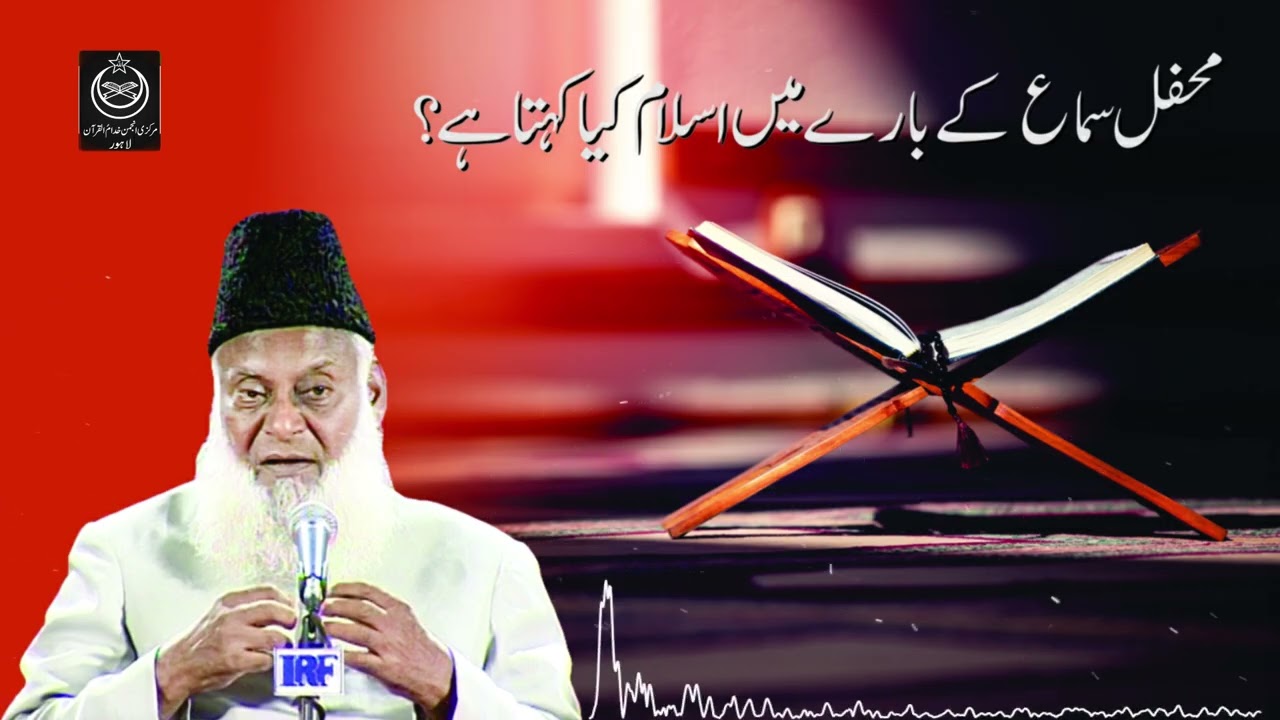
In this clip Dr Israr Ahmed explains that mahfil-e-sama is allowed in Islam with certain rules. It should focus on Qur'an recitation, Allah's praise, or spiritual poetry, delivered in a good voice. The Prophet (PBUH) encouraged listening to the Qur'an, which deeply moved him. The reciter must be a mature man, not a child or effeminate, and no musical instruments should be used. The goal is to inspire faith and spirituality in a lawful way.

In this clip Dr Israr Ahmed talks about why Jews consider "undh" (camel) meat forbidden and how it's slaughtered differently. He explains that it's not just about cutting its throat but striking its neck bone while it stands, symbolizing its unique status. He also mentions Prophet Yaqoob's aversion to undh (camel) meat.

In this clip Dr Israr Ahmed explains that people try to feel better about their bad actions by doing some good deeds. The "nafs-e-lawwama" is our inner voice that makes us feel guilty when we do something wrong. Different people have different ideas about what it means to be good. Some focus on religious rituals but might act unethically in other ways, still thinking they are good. This shows how views on righteousness can vary.

In this clip Dr Israr Ahmed talks about being patient during tough times. He says the Quran teaches us to seek help through patience and prayer. Tests will come, like fear and loss, but we should stay strong, support each other, and keep faith in Allah. Those who die in Allah's path are still alive in a way we can't see.

In the video Dr Israr Ahmed warns about the impact of feminism in Pakistan, attributing it to Western influence. He predicts societal breakdown, where traditional roles are disrupted, and same-sex marriages become common. He highlights a 1994 conference in Cairo advocating for gender equality, including criminalizing marital rape and equal inheritance rights, which he sees as a threat to Islamic values.

In this clip Dr Israr Ahmed explains that true righteousness in the Quran means having sincere faith and doing good deeds consistently. It’s not about outward appearances but about living by Islamic principles and standing firm in Allah's path. Genuine faith drives meaningful actions, making superficial displays of piety empty. True righteousness involves a complete, honest approach to faith and practice.

In this clip Dr Israr Ahmed explains that both men and women have the same religious duties like faith, prayer, fasting, and charity. While men usually pray in mosques, women are encouraged to pray at home. In spreading Islam, men have a broader public role, but women focus more on influencing their family. Even small efforts by women can have great value in Islam.

In this clip, Dr Israr Ahmed explores Khilafat-e-Salasah, a pivotal era in Islamic history. Rebellion during the Prophet's time led to battles, and the martyrdom of Khulafah-e-Rashideen followed. This cycle of revolution and counter-revolution saw opponents converted, as in Mecca's conquest. Hazrat Abu Bakr's legacy and Hazrat Umar's role in the Persian Empire's downfall are significant. Rome and Persia's legacies, in Surah Ar-Rum, symbolize historical shifts.

In this clip Dr Israr Ahmed talks about Hazrat Imam Hussain's (R.A) bravery in Karbala, showing how he stood up for what's right, even when it was hard. He teaches us to fight for justice and be ready to give up everything for it. Hazrat Imam Hussain's (R.A) sacrifice reminds us to stay strong and stay true to what we believe in, no matter what.

In this clip Dr Israr Ahmed talks about "Ilm-e-Ghaib" (knowledge of the unseen) in Islam. It explains that Ghaib includes things we cannot see, like angels, though Prophet Muhammad (SAW) saw them in their true form. The Prophet's knowledge is given by Allah, not something he has on his own, and it's not unlimited. The speaker stresses that we should be careful when discussing the extent of the Prophet's knowledge, as only Allah knows everything. The key point is that we must understand our limits in comprehending these matters.

In this clip Dr Israr Ahmad talks about "sadaqa jariyah," which means giving in a way that keeps helping even after you're gone. It could be building mosques, teaching about religion, doing missionary work, or giving water. He says raising good children is a big way to keep doing good, even after you've passed away.

In this clip Dr Israr Ahmed explains that Islam allows taking captives only during legitimate wars (Jihad), not by forcefully capturing free people, which is strictly forbidden. Prisoners of war (POWs) can be integrated into society instead of being confined to camps. Relations with such captives are permitted without marriage, but freeing and marrying them is encouraged as a noble act. Selling captives was allowed historically under strict rules but is not applicable today. Forced slavery is strictly prohibited in Islam.

In this clip Dr Israr Ahmed explains that shirk, or associating partners with Allah, is a severe wrongdoing with three main types: shirk in belief (misconceptions about Allah), shirk in actions (acting as though others share in Allah's authority), and shirk in attributes (attributing divine qualities to others). He highlights that shirk is the opposite of Tawhid (pure monotheism) and is an unforgivable sin according to the Quran. This concept is fundamental in understanding the gravity of placing anything or anyone in Allah's divine position.