热门视频
In this clip Dr Israr Ahmed explains the difference between weak faith and hypocrisy. Weak faith leads to a lack of passion in worship and adherence to Shariah but involves self-awareness and efforts to improve through repentance. Hypocrisy, however, includes actions that contradict faith or deliberate hostility towards Islam and sincere believers. Hypocrites hide their true intentions, develop jealousy, and oppose those dedicated to Islam. Weak faith is an internal struggle, while hypocrisy is marked by deceit and defiance.

In this clip Dr Israr Ahmed explains that Bai'ah is a pledge to support Allah’s deen, where both men and women commit to following His commands. Men pledge to obey their leader as long as it aligns with Shariah, while women vow to avoid actions displeasing to Allah. Both pledge to sacrifice wealth and life for the cause of Islam. The commitment involves striving for the religion, even in difficult times. Ultimately, the goal is to raise Allah’s deen and make His name supreme.

In this clip, Dr.Israr Ahmed emphasizes that the Quran offers guidance specifically for those with taqwa (piety). Simply memorizing or interpreting the Quran isn't enough if one lacks taqwa. Without it, a person’s character and actions may still be poor. He compares this to placing valuable books on a donkey, which gains no benefit. Therefore, true benefit from the Quran comes only with taqwa.

In this clip Dr Israr Ahmed explain that Hazrat Ali (RA) did not have his own house at one point, but a generous Ansari companion offered a room for his marriage to Hazrat Fatima (RA). When asked about the dowry, Hazrat Ali (RA) mentioned having a shield, which is a weapon for battle. Despite his poverty, Hazrat Ali (RA) was not unsuccessful; rather, he was a successful companion of Prophet Muhammad (SAW).

In this clip Dr Israr Ahmed explains that when non-Muslims convert to Islam, they should focus on the core teachings, not on sects. Some groups, like Deobandi, follow sects, while others, like Jamaat-e-Islami, do not. He highlights how sectarian divisions can confuse and discourage potential converts. Despite these issues, many people are still embracing Islam globally.
In this clip Dr Israr Ahmed explains that the first four caliphs were chosen by consultation and mutual agreement among companions, not by claiming power themselves. This consultative process is what makes their rule (Khilafat-e-Rashida) unique and different from later rulers like Hazrat Muawiyah, who gained power through other means.
In this clip Dr Israr Ahmed highlights the importance of connecting directly with the Quran by learning Arabic, as translations cannot capture its full spiritual and emotional impact. He encourages students to focus on Quranic teachings during their education, as this was the foundation of the Prophet's training system. Learning Arabic, he says, is achievable and key to truly understanding Islam.

In this clip Dr Israr Ahmed explains that "Taghoot" refers to anything or anyone that demands worship or obedience other than Allah. It can also mean crossing boundaries, such as idolizing something beyond its rightful place. Forcing submission to anyone except Allah is considered "Taghoot." True Islamic leadership does not seek to make people submit to them, but to Allah alone.
In this clip Dr Israr Ahmed explains that in financial matters, a man’s testimony equals two women’s as per Allah’s command. He suggests this is due to women’s natural tendency to forget, designed by Allah for their supportive roles, with forgetfulness acting as a safeguard to help them move on from past experiences.

In the clip, Dr. Israr Ahmed discusses hypocrites and the Battle of the Trench. He explains how "fooq" in the Quran refers to Jews and nearby tribes. The believers face a severe test, akin to a climax, exposing hypocrites who seek excuses to leave the battlefield out of fear for their lives.

Mout Ke Bad Kiya Hoga | Surah Ad Dahar Translation & Tafseer By Dr Israr Ahmed | Zindgi Aur Mout

In this clip Dr Israr Ahmed explains that Muslims are meant to be a community that guides others towards truth and goodness. The purpose isn't to gain power or wealth, but to fulfill the responsibility of spreading Allah's message to everyone, ensuring that no one can say they didn't receive it. This mission is vital, as those who receive the message will be held accountable on the Day of Judgment.

In this clip Dr Israr Ahmed explains that Islam’s foundation is about following core principles, but extremism ("bunyad parasti") is not part of Islam. He says that while Muslims should stay firm on their beliefs, they shouldn’t be labeled as extremists. The term "fundamentalism" was first used to criticize Jews and Christians who resisted changes to their religion, and now it’s used against different religious groups, not just Muslims.

In this clip Dr Israr Ahmed explains that people form new groups when they feel existing ones don’t meet their goals. He doesn’t consider other groups un-Islamic but thinks they may not fully meet today’s needs. He went through different groups before starting Tanzeem-e-Islami. He advises choosing a group that feels right, committing to it, and staying open to better paths if they appear.

In this clip Dr Israr Ahmed highlights the need for knowledge to revive Islam, prioritizing understanding of Allah’s commands, the Prophet’s teachings, and the Quran. He explains that sciences and technology are useful but secondary. The focus should be on religious knowledge and wisdom. Additionally, learning philosophy, economics, and ideologies is essential for addressing modern challenges.

In this clip Dr Israr Ahmed explains that joining Tanzeem-e-Islami requires two main commitments. First, a pledge to Allah to avoid what He dislikes and strive for Islam’s success with one’s wealth and life. Second, a pledge to follow the leader’s instructions, whether easy or hard, as long as they align with Islamic teachings. Members must uphold discipline, unity, and dedication to the mission. This structure is rooted in the Quran, Sunnah, and the practice of the Sahaba.
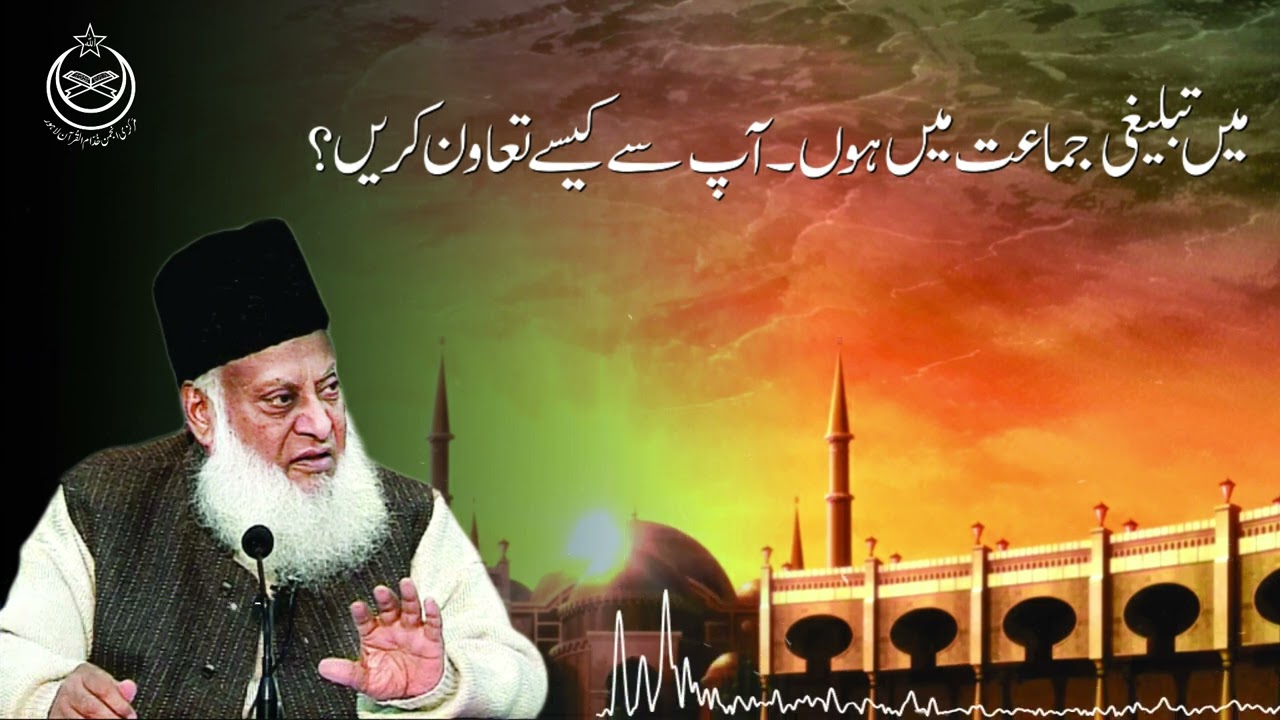
In this clip Dr Israr Ahmed explains that every Muslim should work for Islam, and different groups like Tableeghi Jamaat, Jamaat-e-Islami, and Tanzeem-e-Islami use different methods. While Tableeghi Jamaat focuses on personal efforts and self-improvement, all groups aim to serve Allah with sincerity. Despite their different approaches, the goal is to please Allah through honest and dedicated efforts.

In this clip Dr Israr Ahmed discusses whether Arabs are aware of the destruction that might befall them and if there’s a wise leader among them to warn against it. He shares three hadiths highlighting future challenges for Arabs, mentioning that some ignore such warnings. He emphasizes his views are based on Quran and Hadith, even if some nations dislike his statements about Arabs' future and its potential impact on Pakistan.

In this clip Dr Israr Ahmed explains that if a wife admits to zina (adultery) and repents, the husband should forgive her, as repentance can erase the sin. If the husband wants to punish her, both must swear oaths to confirm the truth. The husband must swear four times, and the wife can also swear to deny the accusation. If both are truthful in their oaths, the wife avoids punishment. The situation should be handled with fairness, privacy, and according to Islamic guidelines.

In this video, Dr. Israr Ahmed talks about how a life-changing accident led him to leave his medical career and focus on preaching Islam. Without any formal organization, he dedicated himself to spreading Islamic teachings, founding Anjuman Khudam al-Quran and Organization of Islam, and spent his life serving Allah without seeking personal gain.