Top videos

Hazrat Ali (R A) Ki Shahadat | Reality & Proof By The Real History | 21st Ramadan | Dr Israr Ahmed

In this clip Dr Israr Ahmed explains that in Islam, the most important duty at a given time takes priority. Ignoring it, even for other good deeds, holds no reward. For example, during a battle, fighting is necessary, and personal worship at that time would not be rewarded. Rewards depend on fulfilling the right responsibility in the right situation.

In this clip Dr Israr Ahmed advises that to find the right group for religious efforts, it should be based on true Islamic principles, not sects. The group's goal should be to change the system, not just perform good deeds. It should have strict discipline, a clear plan for establishing Islamic leadership, and sincere leadership. If a group meets these criteria, joining it is important.

In this clip, Dr. Israr Ahmed explains the difference between doing shirk (associating partners with Allah) and being called a mushrik (one who regularly does shirk). Just committing shirk doesn’t mean someone becomes a mushrik right away. He also advises not to avoid congregational prayers, even if you don't want to pray behind a certain person, as long as their beliefs are correct.

In this clip Dr Israr Ahmed explain that in Madina, the Prophet Muhammad (SAW) prayed facing Jerusalem for 16-17 months, likely by divine guidance. This period helped avoid conflict with the Jews and allowed him to establish his position. He built Masjid-e-Nabwi, bonded migrants and helpers, and formed a defense pact. Later, the Qibla was changed to the Kaaba in Mecca, a significant event in Islam.

In this clip Dr Israr Ahmed talks about keeping promises, especially to God. He shares a story about a loyal companion of Prophet Muhammad (PBUH) who always kept his word. Dr Israr Ahmed stresses that fulfilling promises is crucial in religion. In prayers, Muslims promise to worship and seek help only from God. Those who break promises lack faith and integrity.

In this clip, Dr. Israr Ahmed talks about how Pakistan was created, comparing it to Israel's formation based on religion. He explains that while religion played a big role in Pakistan's birth, there was also a feeling of fear among Muslims about being outnumbered by other communities. He emphasizes the importance of understanding and protecting Pakistan's Islamic identity for its continued existence and success.
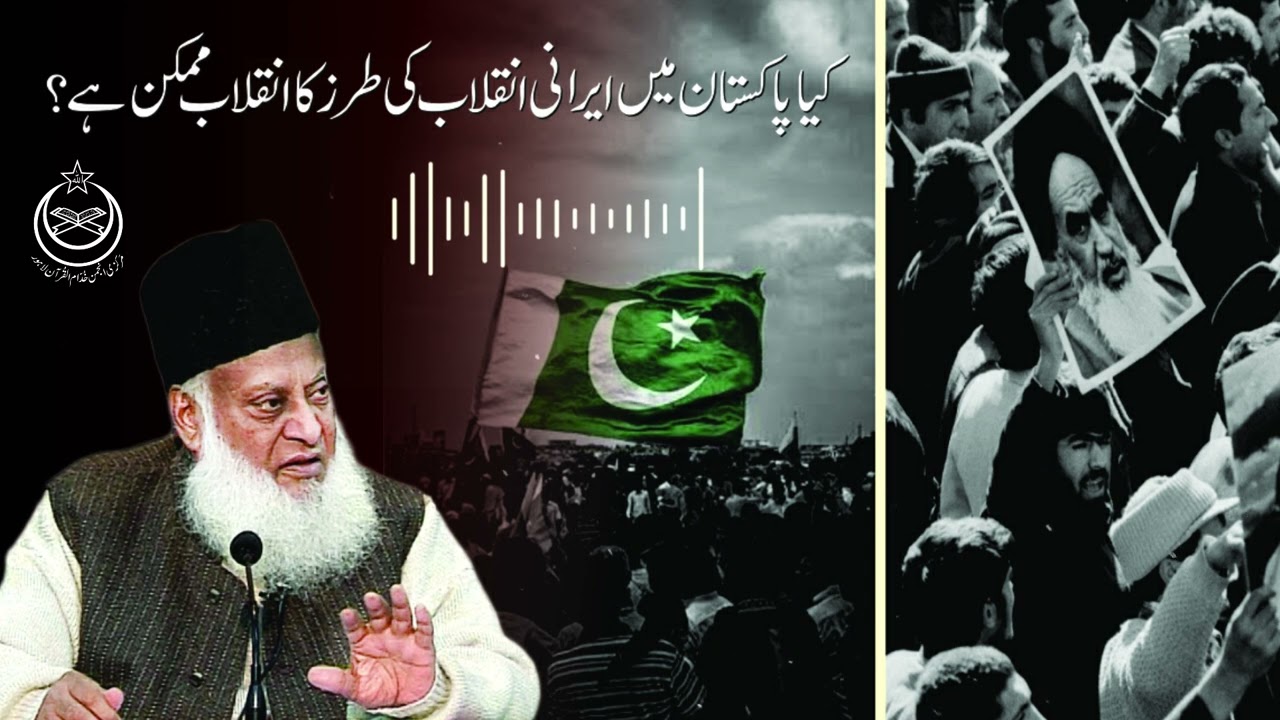
In this clip Dr Israr Ahmed explores whether a revolution like Iran's is possible in Pakistan, highlighting that Iran’s revolution focused on removing un-Islamic leadership and empowering scholars. He acknowledges differences in Shia and Sunni views on leadership and believes that a similar revolution in Pakistan would require much more effort and a different approach, as political elections or preaching alone wouldn't achieve it.

Dr. Israr Ahmed discusses how both sinners and innocents may face consequences in the Quran. Allah promises protection for those who promote good and deter evil, but severe punishment awaits those who persist in immorality and indecency.

In this clip Dr Israr Ahmed explains that "ikhtilaf" means disagreement, which is normal and can happen respectfully, like the differences between scholars. However, when these disagreements lead to division and hostility within the community, it's called "tafarruq," which is harmful. He emphasizes that while disagreements are natural, they should not break the unity of the Muslim community.

Dr. Israr Ahmed discusses his disappointment with the political leadership's failure to implement Islamic principles in Pakistan over the past 40 years, despite his efforts since 1974. He reflects on his attempts to advocate for Islamic governance and shares instances of disillusionment, including the adoption of secular laws instead of Islamic ones.

In this clip Dr Israr Ahmed explains the principles of the state of Madina and condemns interest (sood) as a major sin in Islam. He compares it to committing adultery with one's mother and emphasizes the importance of avoiding it to escape Allah's punishment. In Madina, zakat was collected from businesses as a form of charity.

In this clip, Dr Israr Ahmed emphasizes maintaining hope in Allah's love and mercy. He highlights Surah Baqarah's reminder that Allah doesn't burden us beyond our capabilities. Thus, judgment is tailored to individual resources and abilities. Unlike worldly laws, Allah assesses intentions accurately. His aim is to grant ease, not hardship, to every individual.

In this clip Dr Israr Ahmed explains the significance of time and human existence in the Quran. He discusses "Asr," which means time that passes quickly, and "Dahr," which means the vast expanse of time and space. He notes that humans started as insignificant drops of water. The Quran swears by "Asr" to highlight how quickly time passes and that as we age, our remaining time decreases.

In this clip Dr Israr Ahmed believes prayer should prevent us from wrongdoing. However, if we don't grasp its essence, we might recite mechanically. Real prayer involves feeling close to Allah and being humble. This connection transforms us from within.

In this clip Dr Israr Ahmed explains that striving for the establishment of Islam (Iqamat-e-Deen) is a personal duty for every Muslim. However, its success depends on Allah's will and people's acceptance. He emphasizes that we must continue our efforts without being discouraged by the results, as outcomes are in Allah's control. Dr. Israr also advises against criticizing other religious groups for their methods.
In this clip Dr Israr Ahmed talks about how life has five stages, similar to a plant's growth. He says each stage is important, from being a baby to growing up. He compares human life to how plants grow from seeds to crops, showing how life has its own natural rhythm.

In this clip Dr Israr Ahmed's predictions about the Taliban's rise are proving true after 18 years. He believes success comes to those who trust in Allah. Dr. Israr Ahmed discusses the ongoing bloodshed in Afghanistan and the sincere intentions of those fighting for Islam. He predicts the return of Taliban rule and urges patience and reliance on Allah's guidance.

In this clip Dr Israr Ahmed explains that in early Islamic governance under Mullah Umar, there were no significant resources or funds. Despite this, they enforced Islamic punishments, which greatly reduced crimes like theft, adultery, and robbery. He believes that applying these strict punishments can nearly eliminate crime in society.

In this clip Dr Israr Ahmed talks about how Hazrat Abu Bakr Siddique (RA) gave up all his wealth and even freed slaves to support Islam and Prophet Muhammad (SAW). Despite being rich, he spent everything to migrate with the Prophet (SAW) showing his deep faith and commitment to Islam.