Top videos

Rise Of Islam | ALLAH Ka Wada | Promises Of ALLAH in Quran | Dr Israr Ahmed Powerful Reminder For Um
In this clip Dr Israr Ahmed says that Allah promised the rise of Islam, but Muslims today aren't making enough effort or showing enough faith. He points out that during Prophet Muhammad's (SAW) time, Allah's promises were quickly fulfilled. If Muslims today have true faith and take action, they will see these promises come true as well.

In this clip Dr Israr Ahmed explains that the revolution brought by Prophet Muhammad (PBUH) happened through the teachings of the Quran, not by force. The Quran changed people's thinking, beliefs, and way of life, making them see life and death differently. It was this inner transformation, not the sword, that brought about the true revolution.

In this clip Dr Israr Ahmed explains that if a wife admits to zina (adultery) and repents, the husband should forgive her, as repentance can erase the sin. If the husband wants to punish her, both must swear oaths to confirm the truth. The husband must swear four times, and the wife can also swear to deny the accusation. If both are truthful in their oaths, the wife avoids punishment. The situation should be handled with fairness, privacy, and according to Islamic guidelines.
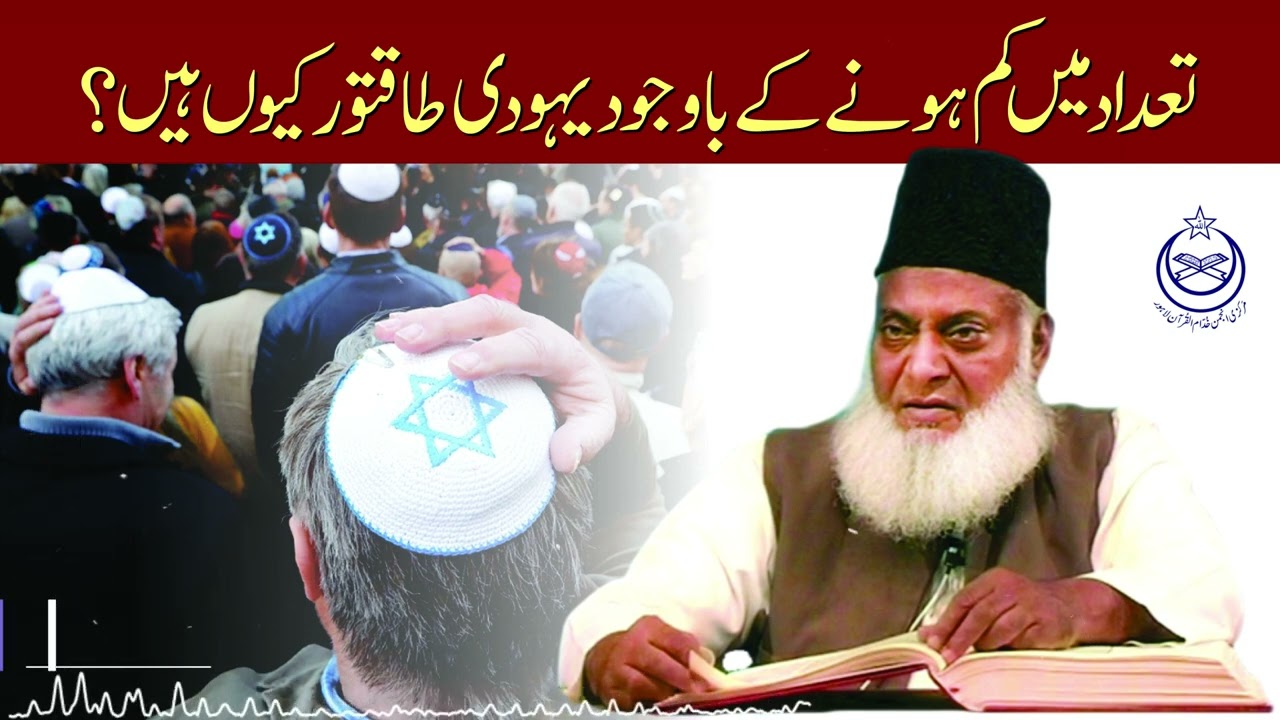
In this clip Dr Israr Ahmed explains why Jews are powerful despite being fewer in number than Muslims, who have the Quran and Sunnah. He says Jews are smart, organized, and work together well. Being a minority makes them active and focused, while larger groups can become passive. Jews have a strong identity and nationalism, allowing them to recover from setbacks. In comparison, Muslims are diverse, which can make it harder for them to unite.

In this clip Dr Israr Ahmed clarifies that not every fight for an Islamic government is jihad fi sabilillah (struggle for Allah). True jihad promotes Islamic values, like in the early caliphate. In Kashmir, freedom fighters are involved in jihad-e-hurriyat, which is valid but may not be true jihad unless it aligns with Islamic goals. Dr. Israr Ahmed states that an Islamic government must follow Islamic teachings; otherwise, its legitimacy can be questioned.
In this video, Dr. Israr Ahmed explains the true meaning and proper method of performing istikhara, emphasizing its importance. He advises entrusting matters to Allah, and if there's good in it, Allah will make it easy. Dr. Israr also discusses whether a sign in a dream at night is necessary for istikhara.

In this clip Dr Israr Ahmed explains that in the final era of the Muslim community, there will be a debate about which part—early or late—is better. This idea, passed down through Hazrat Jafer Sadiq, suggests that later generations might surpass earlier ones in both quantity and quality, likened to different groups benefiting from rainfall in alternating years.

In the clip, Dr. Israr Ahmed advises on conducting a marriage ceremony, emphasizing the importance of announcing it in a mosque, following Prophet Muhammad's (SAW) guidance. He stresses the significance of sincere prayers, contrasting ideal weddings with distractions like smoking. Dr. Israr Ahmed highlights the sacredness of marriage and suggests that the wedding feast in the mosque is the only invitation needed.

In this video, Dr. Israr Ahmed explains how Allah created humans, jinn, and Shaitan. He talks about how Allah made Adam from clay and gave him life. Dr. Israr ahmed also discusses the difference between creatures with consciousness (like angels, jinn, and humans) and those without (like animals and plants). He emphasizes the importance of obeying Allah's commands and discusses the consequences of disobedience, using the story of Adam and Shaitan as examples.

In the video Dr Israr Ahmed discusses trusting Allah (tawakkul) and having taqwa (piety). Taqwa means always being aware that Allah is watching and that we are accountable for our actions. True taqwa helps us move from basic belief to deeper faith and excellence in worship. With taqwa, Allah gives us inner guidance to know right from wrong. This makes us beloved to Allah and helps us grow spiritually.

In this clip Dr Israr Ahmed explains that astrology and palmistry are discouraged in Islam, as they lead people away from trusting Allah’s guidance. While some may believe these practices hold truth, Islam prohibits relying on them. Instead, Muslims should seek guidance from the Quran and Sunnah. Focusing on hard work and faith is the correct path, rather than turning to superstitions.

In this clip Dr Israr Ahmed advises Indian Muslims not to support secularism because it goes against Islamic beliefs. He explains that secularism separates religion from daily life, leading to practices that Islam does not allow. He encourages Muslims to focus on creating an Islamic system instead of following secular ideas. Dr. Israr Ahmed emphasizes the need to stay true to Islamic teachings in all parts of life and work towards spreading these values.

In this clip Dr Israr Ahmed discusses the concept of intercession (Shafa'at) in Islam, explaining that it is a complex issue. He mentions that while the Quran denies certain types of intercession, it also allows intercession for those whom Allah grants permission. Intercession is not about someone having the power to act on their own but requires divine approval. Dr. Israr emphasizes that the idea of intercession should be understood correctly and that it is only valid if Allah permits it.

Iqamat e Deen Farz Hai | What is Iqamat e Deen | Dr Israr Ahmed Eye Opening Bayan

In this clip Dr Israr Ahmed explains that Prophet Muhammad (SAW) is special among all prophets because of his unique role. He also talks about Prophet Ibrahim (AS) and his descendants, who became the ancestors of many prophets. Prophet Musa (AS) led his people out of Egypt, but Prophet Muhammad (SAW) successfully established an Islamic state with the help of his companions. The key point is that Prophet Muhammad (SAW) holds a unique and unmatched status.

In this clip Dr Israr Ahmed explains that a peaceful Islamic revolution requires addressing sectarian divides. While Muslims differ on minor issues, they agree on core principles like modesty and morality. He highlights past unity among sects on shared values, showing that collective change is possible if focus shifts from divisions to the essence of Islam.

In this clip Dr Israr Ahmed discusses the differing opinions on performing Juma prayers while traveling. Hanafi scholars do not permit combining prayers like Fajr, Zuhr, Asr, Maghrib, and Isha during travel, while other sects like Ahl-e-Hadith allow it. He emphasizes respecting each sect's interpretation without criticizing others. Dr. Israr also mentions that if Zuhr prayer is difficult to perform during travel, it can be delayed until Asr time. However, combining Zuhr and Asr immediately is not allowed.

In this clip, Dr. Israr Ahmed discusses his prediction about Pakistan's Transgender Bill coming true. He talks about the loss of shame and modesty, and how Western values like homosexuality and gender equality are being imposed on Muslim societies. Dr. Israr ahmed warns that these efforts aim to destroy Islamic values and family structures. He highlights the push to normalize homosexuality, legalize same-sex marriages, and change gender roles within families as part of a broader agenda against the Islamic world.

In this clip Dr Israr Ahmed explains that true love for the Prophet Muhammad (SAW) is shown by fully following his teachings and obeying Allah. Simply claiming to love the Prophet isn’t enough; it must be backed by action. On the Day of Judgment, some may find that their claims of love were not accepted by Allah because they didn’t truly follow the Prophet. Obeying Allah and His Messenger is essential in Islam, and sincere repentance is always accepted by Allah.

In this clip, Dr Israr Ahmed discusses Prophet Muhammad (PBUH) and his companions' sacrifices and dedication to spreading Islam. They abandoned worldly pursuits, endured hardships, and remained steadfast in their commitment despite facing immense challenges, ultimately receiving great rewards from Allah for their efforts.