Top videos

In this clip Dr Israr Ahmed explains that religious groups struggle to unite on implementing an Islamic system because of petty disagreements and lack of action. He shares his experience with the Mutahida Shari Muhaz, where efforts failed due to internal conflicts and lack of commitment to a common goal. He stresses that real progress needs unity, sincerity, and willingness to prioritize the greater good over personal interests.

In this clip Dr Israr Ahmed talks about five predictions by Prophet Muhammad (SAW) for the end times, echoed by Allama Iqbal. Despite current difficulties, these predictions bring hope. The five eras are: the Prophet's time, the Righteous Caliphs, Muslim Empires, Oppressive Kings, and finally, a return to righteous rule. This last era will be global and restore hope for believers.

In this clip Dr Israr Ahmed explained that merely practicing parts of Islam is not enough for Jannah. One must work to change systems that don't follow Islamic values. Even if someone follows basic practices like prayer and fasting, they must reject and struggle against un-Islamic systems. Efforts to change the system and follow true Islamic principles are key to salvation.

In this clip, Dr Israr Ahmed talks about whether Prophet Muhammad knew things that couldn't be seen. He says some people believe he did, because Allah gave him knowledge. Others disagree. Dr. Israr Ahmed says denying the Prophet's knowledge goes against the Qur'an. He explains that while no one can know everything like Allah, Prophet Muhammad was given special knowledge by Allah.
In this clip Dr israr Ahmed explain that Islam recognizes only two Eids: Eid-ul-Fitr and Eid-ul-Adha, while Eid Milad-un-Nabi, commemorating the Prophet Muhammad’s (PBUH) birth, is not a prescribed religious festival. Acts of kindness on this day, like feeding the poor, are permissible, but celebrations and processions resemble non-Islamic traditions and were historically introduced for social reasons. Thus, while honoring the Prophet’s birth through good deeds is encouraged, observing it as an Eid has no foundation in Islamic teachings.

In this clip Dr Israr Ahmed explains the difficulty of maintaining faith during tough economic times. He urges Muslims to stay committed to their religion and study the Quran. He encourages different Islamic groups to work together and trust in Allah, who provides help in unexpected ways. Overall, he highlights the importance of unity and deepening faith to face today’s challenges.

In this clip Dr Israr Ahmed explains that Masjid-e-Aqsa was built 40 years after the Kaaba, likely by Prophet Ibrahim (AS). It was later rebuilt by Prophet Sulayman (AS) as Haikal-e-Sulaymani. Over time, it was destroyed and rebuilt several times, with the Romans demolishing it in 70 CE. By the time of Prophet Muhammad’s (PBUH) Miraj, it was in ruins, though some remains may have existed.

In this clip Dr Israr Ahmed explains that once a person reaches maturity, they are responsible for fulfilling religious duties. He believes real change comes by educating adults, rather than focusing on separate schools for girls. Spiritual growth is achieved through the teachings of the Quran, which help cleanse bad habits. Educational reforms, he suggests, will follow after a societal revolution.

In this video, Dr. Israr Ahmad underscores the importance and significance of the Quran. He emphasizes the greatness (Azmat) and significance (Ahmiyat) of the Quran, highlighting the wisdom (Hikmat) embedded in its teachings. Dr. Israr Ahmad encourages repeated reading of the Quran to gain knowledge (Agahi) and emphasizes the transformative power of its illumination (Roshni) in acquiring wisdom and guidance.

Dr. Israr Ahmed discusses the concept of sovereignty, comparing the claims of Pharaoh, Numerud, and even humans in democracies to Allah's true sovereignty. He emphasizes that humans are Allah's representatives on earth and should implement His orders.

In this clip Dr Israr Ahmed explains that in Islam, both the outward actions and inner sincerity of good deeds are essential. He emphasizes that religious practices, like prayer, should involve proper practice and true inner devotion. Neglecting either aspect is incorrect. True goodness requires attention to both external actions and internal sincerity. He also mentions that some Sufi practices wrongly overlook these outward forms.

In this clip Dr Israr Ahmed advises that to find the right group for religious efforts, it should be based on true Islamic principles, not sects. The group's goal should be to change the system, not just perform good deeds. It should have strict discipline, a clear plan for establishing Islamic leadership, and sincere leadership. If a group meets these criteria, joining it is important.
In this clip Dr Israr Ahmed explains that belief (yaqeen) is formed through personal experiences, which can be external or internal. External experiences involve using our senses, like tasting sugar to confirm its sweetness, while internal experiences are deep emotional or spiritual realizations, such as feeling moved by poetry. True conviction arises when these experiences, whether physical or spiritual, validate what we hear or know, making our belief firm and meaningful.
In this clip Dr Israr Ahmed explains why he openly discusses his revolutionary process, unlike some groups that keep their plans secret. He believes transparency is important for people to understand the vision, drawing from historical examples like the Prophets (SAW). He acknowledges that people resist change without full understanding, but stresses that openness is essential. For him, sharing the process is neither a mistake nor a crime, but a necessary step for achieving a clear goal.
In this clip Dr Israr Ahmed explains how to succeed by keeping things simple with the Quran's clear guidance. He says even though the Quran is deep, its early parts are easy to understand and give good advice. He mentions Surah Asr, which talks about faith, doing good, and helping each other as the keys to success.

In this clip Dr Israr Ahmed explains that mentioning the Rightly Guided Caliphs (Khulafaye Rashideen) in Jumu'ah khutbahs is a matter of personal preference. Some believe only Quran and Hadith should be discussed, while others include the Caliphs' names. Dr. Israr Ahmed personally mentions their virtues, as described in Hadith, to highlight their importance in Islam.

Prediction & Secrets About End Of Time | Qayamat Ki Nishaniyan | Dr Israr Ahmed Official
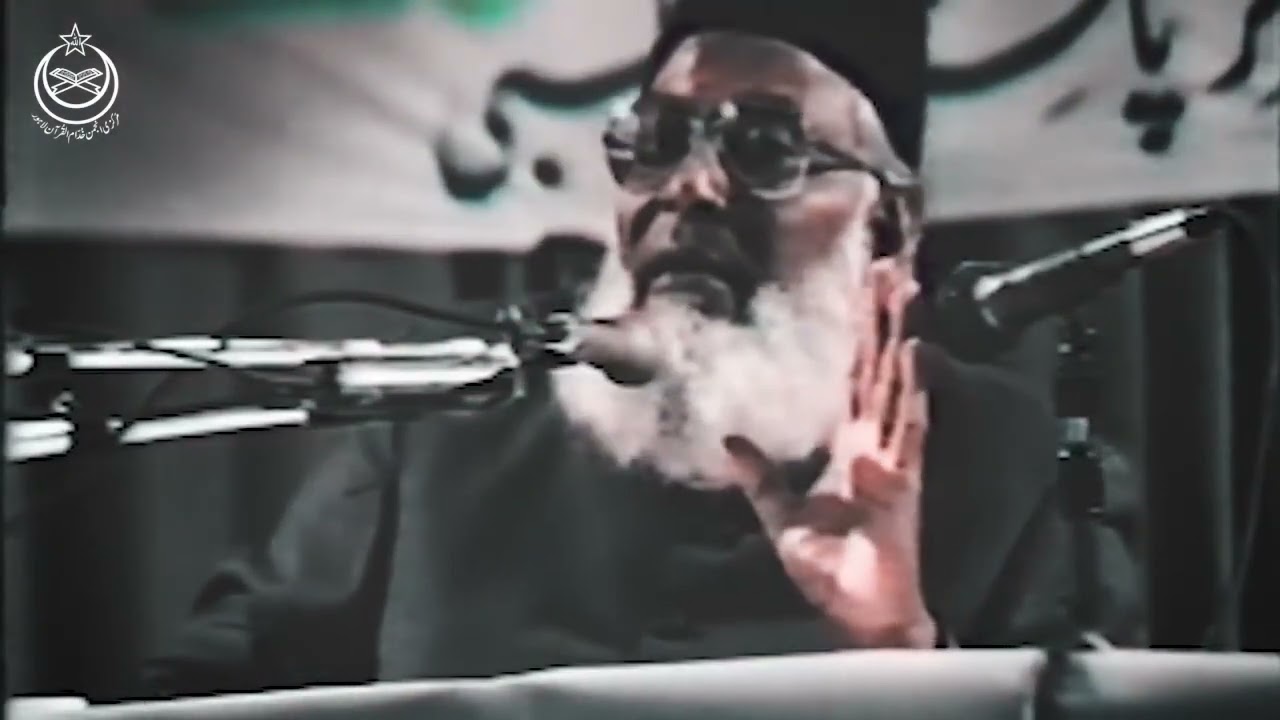
Dr. Israr Ahmed discusses the connection between faith and good deeds, highlighting legal faith versus true faith, and their significance according to the Quran.

Huzoor ﷺ Ki Hazrat Ali رضی اللہ عنہ Ko Nasihat | Powerful Reminder For Muslim Ummah | Dr Israr Ahmed
In this clip, Dr Israr Ahmed discusses Hazrat Ali's advice on facing trials, emphasizing the Quran as the key guide to avoid problems. He urges people to follow its teachings to steer clear of trials. Hazrat Ali's wisdom highlights the importance of seeking guidance from the Quran, which holds lessons from the past and insights for the future.

In this clip Dr Israr Ahmed explains who the hypocrites (munafiqeen) are: those who claim Islam without true faith. Islam requires obedience to Allah and His Messenger without compromise. True believers distinguish themselves from hypocrites by their unwavering faith and belief in the Quran as Allah's word.