Top videos

Shan e Sahaba Bayan Khutba Juma By Dr Israr Ahmed رحمہ اللہ Be Unite We Are Ummah

In this clip Dr Israr Ahmed discusses the Quran's unmatched eloquence and literary beauty. He explains that while everyone can appreciate its message, only native Arabic speakers, especially those from the Prophet's time, can fully understand its linguistic brilliance. Even the best poets of that era admitted they couldn't match the Quran's eloquence.

In this clip Dr Israr Ahmed discusses the scene of Judgment Day, where Prophet Muhammad (SAW) said that people's feet will not move until they're questioned about five things: their life span, youth, earnings, and how they used their knowledge. He emphasizes that even animals won't be exempt from accountability, while humans will face judgment in the afterlife. He also touches upon the philosophy of suffering and the hope of salvation through Allah's mercy.

In this clip, Dr Israr Ahmed differentiates between personal and collective worship, highlighting that individual acts of worship are incomplete without addressing societal injustices. He stresses the importance of societal worship to fulfill true faith, advocating for resistance against societal injustices as integral to worship.
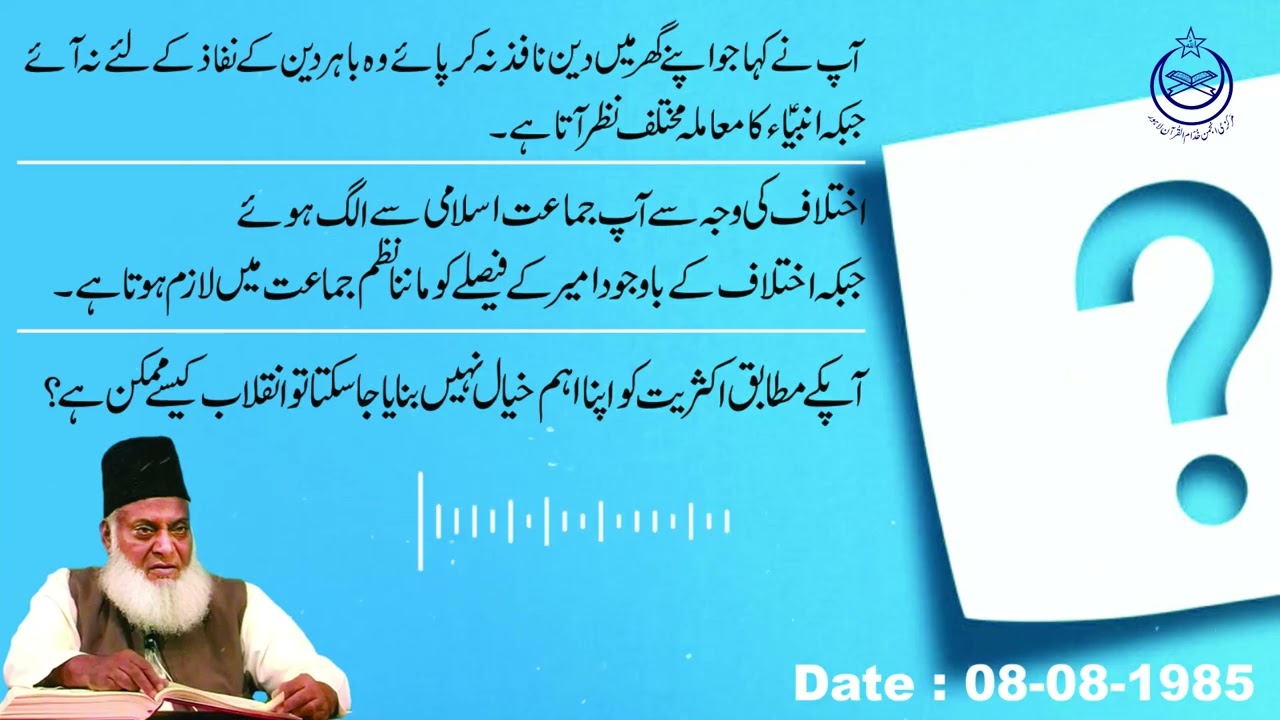
In this clip Dr Israr Ahmed stressed starting with self-reform and applying Islam in personal and family life before spreading it to society. He highlighted that perfection isn’t necessary, but consistent effort is. Using examples from Prophets, he explained the need to balance personal growth and societal change. He also urged unity among Islamic groups, focusing on shared goals rather than divisions, and emphasized respectful dialogue for collective progress.

In this clip Dr Israr Ahmed explains that worship (ibadat) consists of two essential parts: total obedience to Allah and love for Him. These are complemented by additional aspects: sincere devotion and acknowledgment of Allah's representative, the Prophet Muhammad. True worship involves both these elements—complete submission and deep love. Worship is not just about following commands but doing so out of intense love and respect. The obedience to Allah and the Prophet are interconnected, with both being crucial for genuine worship.

Gautam Buddha Story in Urdu Hindi | Life Of Gautam Buddha | Zindgi Ki Asal Haqeeqat By Dr Israr Ahme
In this clip Dr Israr Ahmad discusses Gautam Buddha's life and the essence of suffering. Buddha, once a prince, left his palace to understand human pain. He believed suffering is inherent in life and preached the importance of understanding it for true salvation. According to him, everyone will be held accountable for their actions.

In this clip Dr Israr Ahmed outlines three types of patience: obeying religious commands despite difficulties, resisting temptations, and enduring hardships as tests from Allah. It involves following rules, resisting temptations, and staying strong in tough times, all part of Allah's plan.
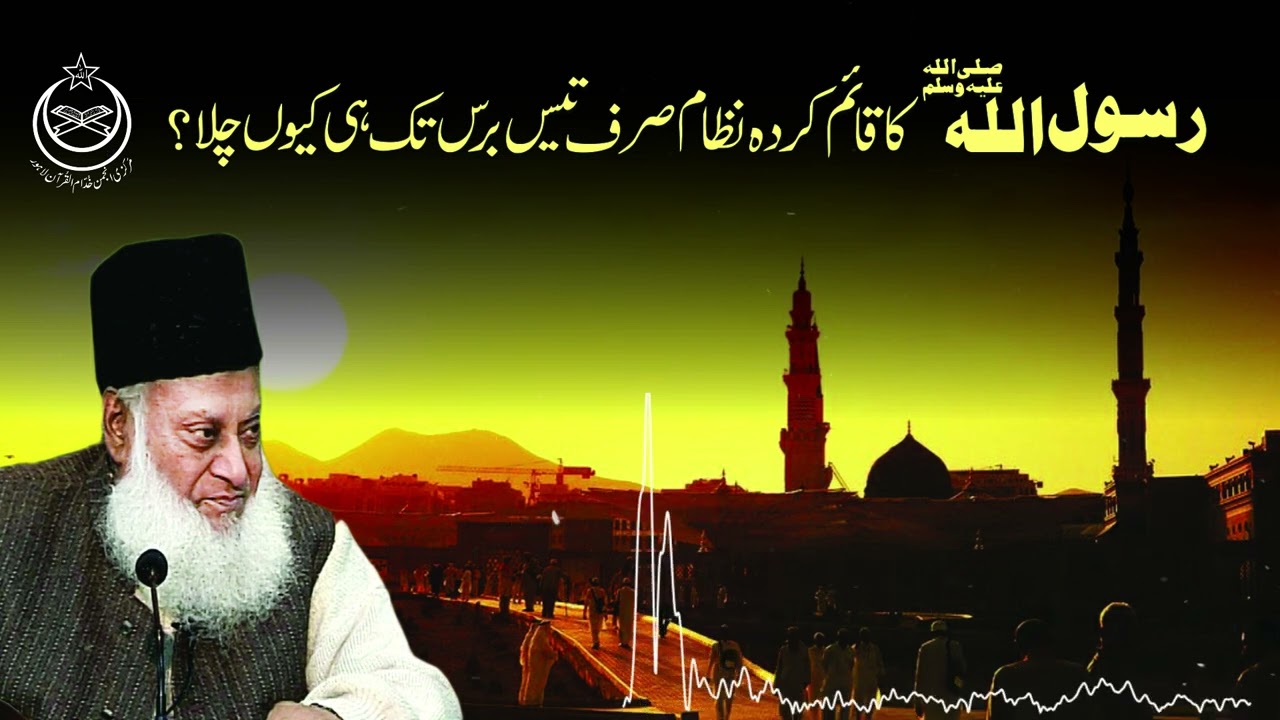
In this clip Dr Israr Ahmed explains that the Islamic system under Prophet Muhammad (PBUH) lasted only 30 years, but it was still a great success. Unlike other systems, Islam worked well during that time. People weren't ready to keep it going longer, and they didn’t fully understand the difference between the state and government. This brief period remains an inspiring example of a fair and just system.

In this clip Dr Israr Ahmed discusses "shirk" (associating partners with Allah) and "hijrat" (migration). He says the best hijrat is leaving anything that Allah dislikes. He encourages people to reflect on their actions and give up anything that goes against Islam, focusing on spiritually distancing themselves from disobedience to Allah.

In this clip Dr Israr Ahmed explains that the Iranian Revolution is not the perfect model of revolution. It brought religious leaders into power but didn’t fully change the system. He mentions that a violent revolution isn’t practical today because governments are too strong. Instead, he suggests peaceful methods to bring change, using the Iranian example of non-violent resistance, though it happened in special circumstances due to Iran’s strong religious background.

IMAM Mehdi Ka Zahoor Kab Ho Ga | Prediction In Hadith | امام مہدی کے بارے میں احادیث | Dr Israr Ahme
In this clip Dr Israr Ahmed shares predictions about Imam Mehdi's coming, referencing several hadiths. One hadith indicates that Imam Mehdi will be a just ruler emerging during difficult times, restoring fairness for seven years in the Arab world. He will be recognizable by his features and fairness, arising from the Prophet's family lineage. Other hadiths highlight Imam Mehdi's spiritual awakening and connection to the Prophet's family.

rahe nijat hd 08

Types Of Shirk Series Part 2 | شرک فی الذات کیا ہے؟ | Shirk Kya Hai | Dr Israr Ahmad Lecture

Prediction About Last World War | دنیا کی سب سے بڑی جنگ | THE MALHAMA FINAL BATTLE ARMAGEDDON

In this clip Dr Israr Ahmed explains that no country, including Pakistan, truly follows an Islamic system. He argues that these countries are run on non-Islamic principles, leading to moral decay, the breakdown of family life, and the normalization of immoral behaviors. He highlights that what Allama Iqbal warned about—the decline of moral and cultural values—has now become a reality.

In this clip Dr Israr Ahmed explains why a grandchild (pota) does not inherit from a deceased grandparent if their own parent (the son or daughter of the deceased) is still alive. If the son is alive, the grandchild does not receive inheritance. However, if the son is deceased, the grandchild can inherit, as the inheritance would pass to the next line. He also explains that while the grandchild may not inherit, they can receive a gift or will from the grandparent during their lifetime, within legal limits.

In this clip Dr Israr Ahmed explains that Islam does not support completely rejecting worldly life. Instead, it encourages living responsibly while maintaining devotion to Allah. Islam values family life and wealth, rejecting the idea of isolating oneself like monks. The Prophet Muhammad (PBUH) emphasized the importance of engaging with the world and following a balanced approach. Islam promotes a harmonious balance between worldly duties and spiritual commitments.

In this clip, Dr. Israr Ahmed discusses Prophet Musa (AS) on Koh-e-Toor and the greatness of the Quran. He explains that the Quran is a reflection of Allah's attributes. A verse from Surah Hashr says a mountain would crumble if the Quran was revealed on it. He also describes how Prophet Musa (AS) fainted when Allah's light appeared on the mountain, showing the power of Allah's words.
In this clip Dr Israr Ahmed explains that in Islam, concubines (londiyan) are war captives considered property with no marriage contracts or inheritance rights. Wives, however, have marriage contracts, legal rights, and can seek separation. The Quran encourages freeing slaves, and Prophet Muhammad (SAW) taught to treat them well and free them as an act of kindness and repentance.