Toppvideor
In this clip, Dr Israr Ahmed talks about who will go to heaven. He says it's those who follow Prophet Muhammad's teachings completely, not just focusing on prayers or cleanliness. He stresses following the Prophet's way without disagreement. He mentions the struggle to spread Islam, even enduring hunger and criticism. Following the Prophet means working hard for Allah's religion.
In this clip Dr Israr Ahmed explains that Mutah (temporary marriage) is haram in Islam as it involves a time-limited agreement, unlike a proper Nikah, which is a lifelong bond. He stresses that Islamic rulings depend on divine evidence, not personal logic. Even if justified to avoid sin, Mutah is not allowed and can lead to misuse, like immoral practices. A valid Nikah requires proper witnesses and follows Shariah guidelines.
In this clip Dr Israr Ahmed explains that true Tawbah (repentance) requires four steps: recognizing the sin, feeling sincere regret, making a firm commitment to avoid it in the future, and immediately abandoning the sinful act. If the sin involves violating the rights of others (haqooq-ul-ibad), one must seek their forgiveness and return any wrongfully taken property or obtain permission. Verbal repentance alone is not enough without these sincere actions.

In this clip, Dr. Israr Ahmed explains how to stay focused during prayer (namaz) by concentrating on the afterlife and love for Allah. He advises that by directing all thoughts toward these spiritual matters, distractions and negative thoughts will diminish. By keeping the mind centered on Allah and the Prophet Muhammad (PBUH), it becomes easier to maintain concentration during prayers.

In this clip Dr Israr Ahmed explains a hadith about two important armies. One will fight in India, and the other will support Prophet Isa (AS). He suggests that when an Islamic caliphate is established, likely starting from Pakistan and Afghanistan, these armies will emerge to fight in India and later move towards Jerusalem, fulfilling the prophecy of the black flags from Khorasan.

In this clip, Dr. Israr Ahmed discusses the miracles of Prophet Muhammad, other prophets, and the Quran's greatness. He emphasizes the Quran's unmatched eloquence and challenges anyone to replicate its beauty. Dr. Israr Ahmed concludes that while other prophets' miracles may have ceased, the miracle of Prophet Muhammad endures forever.

In this clip Dr Israr Ahmed explains the difference between offering and establishing prayer. Establishing prayer involves creating a proper system with mosques, timely Adhan, and men praying together behind an Imam. Jummah prayer needs government-approved mosques and a certified Khateeb. Small, unofficial mosques disrupt this system. Proper prayer organization was historically maintained in central towns, not villages.

In this clip Dr Israr Ahmed talks about the three levels of certainty in faith: knowing something is true (Ilm-ul-Yaqeen), seeing it for yourself (Ain-ul-Yaqeen), and fully experiencing it (Haqq-ul-Yaqeen). He explains this with a Hadith where worshiping Allah as if you see Him makes your faith stronger and more sincere.

In this clip Dr Israr Ahmed explains whether making pictures is haram in Islam. Drawing pictures by hand of living beings is clearly forbidden in Islamic teachings. With the invention of cameras, scholars debated if photography falls under the same rule. Some say it’s allowed for things like education, passports, or criminal identification. While some scholars accept it for necessary purposes, most discourage it, especially for general use.
In this clip Dr Israr Ahmed explains that a man should balance the rights of both his wife and mother, especially when conflicts happen. He advises spending time with parents and showing them love, as neglect can hurt them. It's important not to focus only on one's wife and children, but also care for elderly parents, as they often feel lonely and ignored.
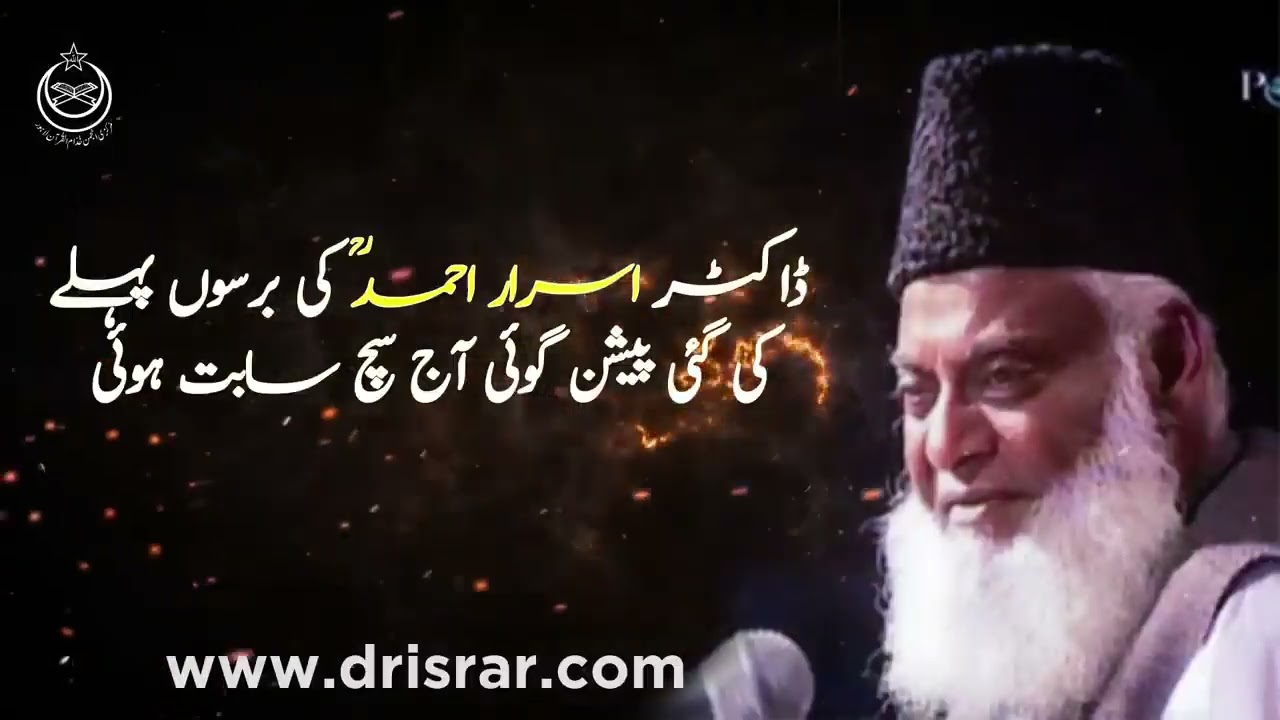
In the video Dr Israr Ahmed criticizes Pakistani politicians for lacking a true connection with Allah and being overly influenced by American policies. He claims that leaders like Benazir Bhutto and Nawaz Sharif, along with other institutions, have compromised their values, and that the real conflict is with Islam itself.

In this clip Dr Israr Ahmed explains the need for ijma (consensus) when companions had differing opinions on issues. For example, after the Battle of Ahzab, Prophet Muhammad (PBUH) told Muslims not to pray Asr until they reached Banu Qurayzah. Some delayed the prayer as instructed, while others prayed on time, interpreting the command differently. Both actions were accepted. This highlights the importance of understanding the wisdom behind commands and using ijma to address disagreements in such matters.

In this clip Dr Israr Ahmed discusses the differing opinions on performing Juma prayers while traveling. Hanafi scholars do not permit combining prayers like Fajr, Zuhr, Asr, Maghrib, and Isha during travel, while other sects like Ahl-e-Hadith allow it. He emphasizes respecting each sect's interpretation without criticizing others. Dr. Israr also mentions that if Zuhr prayer is difficult to perform during travel, it can be delayed until Asr time. However, combining Zuhr and Asr immediately is not allowed.

In this clip Dr Israr Ahmed explains that inheritance in Islam must be fairly divided among family members, with clear shares for sons, daughters, and others. He highlights that keeping property within the family, excluding women or non-Muslims, or claiming property after death is wrong. Misusing inheritance is a big sin in Islam. He stresses that Islamic law should guide how inheritance is divided, not local laws.

In this clip Dr Israr Ahmed discusses Itikaf, a voluntary Islamic practice of worship and reflection in a mosque, focusing solely on Allah. Lasting from an hour to several days, Itikaf deepens spiritual connections and seeks blessings, especially during the last ten days of Ramadan, providing a period of spiritual growth away from worldly distractions.

Prevention of Sexual Violence جنسی تشدد کے واقعات کی روک تھام کیسے ؟ Dr Israr Ahmed R A

Muhammad Ali Jinnah Quaid e Azam Kaise bne | Dr Israr Ahmed Official

In this clip Dr Israr Ahmed explains that Jamaat-e-Islami seeks Islamic governance through elections, while Tanzeem-e-Islami focuses on personal reform and building a committed group to establish Islam through struggle and sacrifice. The two differ fundamentally in their approach, with Tanzeem emphasizing revolutionary action and bai’at as its foundation.

In this clip Dr Israr Ahmed explains that conflicts among the Sahabah escalated due to propaganda and chaos, making it hard to determine who was right. Despite efforts for peace, the situation was too complex to resolve. He highlights that external manipulation fueled the disputes and critiques some historical analyses for ignoring these deeper causes.

In this clip Dr Israr Ahmed talks about not judging people just by how they look. He says what really matters is how we behave. He warns against thinking we're always good, because only God knows our true intentions. He also says we should be kind to others and pray for their guidance, like Prophet Muhammad (PBUH) taught.