Top videos

In this clip Dr Israr Ahmed explains that Allah swears by time in the Quran to show its importance. He says understanding the Quran takes a lifetime, even for great scholars. He compares this to Allama Iqbal's humble approach in his writings. Dr. Israr Ahmed stresses the need for deep study of the Quran and notes its profound verses. By swearing by time, Allah highlights that all people are at a loss except those who believe and do good deeds.

In this clip Dr Israr Ahmed explains the debate on whether good deeds are part of faith. Imam Abu Hanifa says actions are separate from faith and don't affect it. Imam Bukhari believes faith includes both belief and actions, which can increase or decrease. Imam Abu Hanifa views faith legally, meaning even if someone sins, their faith remains, but they are punished for the sin separately.

In this clip Dr Israr Ahmed explains that people try to feel better about their bad actions by doing some good deeds. The "nafs-e-lawwama" is our inner voice that makes us feel guilty when we do something wrong. Different people have different ideas about what it means to be good. Some focus on religious rituals but might act unethically in other ways, still thinking they are good. This shows how views on righteousness can vary.

In this clip Dr Israr Ahmed explains that true righteousness in the Quran means having sincere faith and doing good deeds consistently. It’s not about outward appearances but about living by Islamic principles and standing firm in Allah's path. Genuine faith drives meaningful actions, making superficial displays of piety empty. True righteousness involves a complete, honest approach to faith and practice.

In this clip Dr Israr Ahmed explains that voting ("woot") and "baait" (pledge of allegiance) are different. Voting is a way to choose a leader through consultation, while "baait" is the act of pledging loyalty to the chosen leader. He gives the example of how Hazrat Uthman (RA) was selected as Caliph through a voting process, but the final step was "baait" to show loyalty. Voting helps in decision-making, but "baait" is the real commitment to follow the leader.
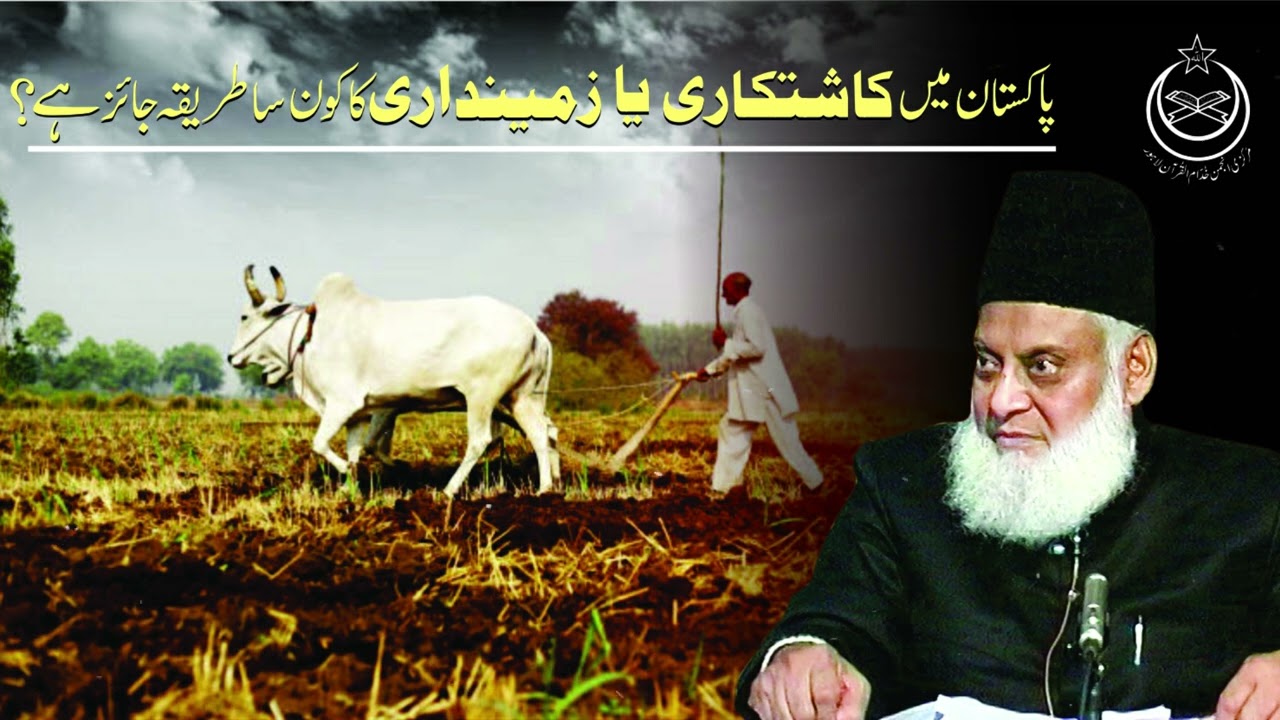
In this clip Dr Israr Ahmed says that, in Islam, land in Pakistan should belong to the state, not individuals. The government should give small portions of land to farmers, who will pay a share of their produce to the state. There should be no big landlords. He also suggests creating a council of scholars to review land laws.

In this clip Dr Israr Ahmed explains that, in Islam, a woman’s main role is to care for her family, while the husband provides financially. Women can work if they follow Islamic guidelines, like wearing hijab. He suggests women-only workplaces, like hospitals and schools, to keep things modest and aligned with Islamic values.
In this clip Dr Israr Ahmed explains that the Quran is profound and no single Tafseer can fully capture its depth. Scholars interpret it based on their knowledge and focus, such as philosophy, logic, or action. Each Tafseer offers a unique perspective but remains limited by human understanding. The Quran’s vastness reflects Allah’s infinite knowledge, beyond complete human grasp.

In this clip Dr Israr Ahmed emphasized four points before joining an Islamic group. First, the group should aim to establish Islam, not just focus on education or reform. Second, it should have a strong, disciplined structure. Third, its methods must align with the Sunnah of the Prophet. Lastly, the leadership should reflect Islamic values through their character and actions. These factors ensure the group is genuinely working for the cause of Islam.
In this clip Dr Israr Ahmed explains that Hazrat Abu Zar Ghafari was asked to leave Madina for preaching that keeping gold and silver without spending it for Allah’s cause is forbidden, based on a Quranic warning about unused wealth becoming a punishment. However, Islam allows lawful wealth if zakat is paid, permitting private ownership and halal earnings, while prohibiting income from haram sources.

In this clip Dr Israr Ahmed emphasizes the importance of living according to Allah’s will by following the Quran and staying connected with a religious group. He advises joining a community for support, avoiding Shaytan's influence, and participating in activities like congregational prayers. Being part of a group like Tanzeem-e-Islami helps maintain the right path, but sincerity and following the Prophet’s way are key.

In this clip, Dr. Israr Ahmed clarifies that Allah is the Necessary Existence, always existing, while all other beings, including humans, are contingent and incidental. He distinguishes between the eternal existence of Allah and the dependent existence of everything else

Dr. Israr Ahmed discusses the concept of sovereignty, comparing the claims of Pharaoh, Numerud, and even humans in democracies to Allah's true sovereignty. He emphasizes that humans are Allah's representatives on earth and should implement His orders.
In this clip, Dr Israr Ahmed talks about Hazrat Umar (A.S)'s time, emphasizing fair leadership and accountability. Dr israr Ahmed also shows how Umar listened to people's problems and chose capable leaders. Dr. Israr also shares stories of Hazrat Umar (A.S) standing up for justice, like punishing someone for disrespecting their mother. He criticizes leaders who forget these values and insists on a system that respects everyone.

In the clip, Dr. Israr Ahmed talks about Prophet Muhammad's farewell pilgrimage speech, emphasizing the repetition of key teachings three times. He stresses the importance of spreading Islam's message, citing a verse from Surah Al-A'raf, and urges individuals to fulfill this duty to avoid accountability on Judgment Day.
The clip explains Dr. Israr Ahmed's view on Prophet Muhammad's last sermon, stressing its relevance for all people, not just Arabs. He talks about Muslims' duty to share the message globally and the challenges they face. Dr. Israr Ahmed mentions how the sermon uses repetition for emphasis and reflects on the Prophet's struggles. He encourages Muslims to follow Islamic principles and spread Islam worldwide.
In this video, Dr. Israr Ahmed talks about loving Prophet Muhammad more than anything else, even more than family. He says this love is important for growing spiritually and having a good society. Dr. Israr Ahmed tells a story about Hazrat Umar loving the Prophet very much. He also says it's crucial to follow the Prophet's teachings for society to be strong and peaceful.
In this clip Dr Israr Ahmed talks about how life is like a journey, not just reaching a goal. He says we should focus more on the afterlife than on this temporary world. He warns that being too attached to worldly things can make us forget about what comes after. Dr. Israr Ahmed advises finding a balance and remembering the bigger picture of life's purpose.

Dr. Israr Ahmad discusses how goodness can become extreme and defines true goodness. He shares stories of individuals who went to extremes in their pursuit of goodness, forsaking worldly pleasures for religious devotion. These narratives highlight Prophet Muhammad's (SAW) advice on moderation in worship to avoid extremism. They illustrate how excessive zeal for goodness can lead to imbalance.

In a short clip, Dr. Israr Ahmed talks about what happens to hypocrites. They pretend to be Muslim but don't truly follow Islam. Hypocrites will be in the worst part of hell. It's hard to deal with them because they betray from within. Allah doesn't like hypocrisy. The Quran says even if Prophet Muhammad (SAW) prays for them, they won't be forgiven.