Seneste videoer
In this clip Dr Israr Ahmed discusses why many religious scholars didn’t take a leading role in Pakistan's creation, though they supported it. Some scholars, like Maulana Abdul Kalam Azad, opposed it, fearing a division among Indian Muslims. He explains that leaders misunderstood the common Muslims' feelings, who were aware of the growing Hindu-Muslim tensions. Ultimately, there was a difference of opinion, but it was based on sincere beliefs.
In this clip Dr Israr Ahmed explains that today’s leader of an Islamic state should be chosen through consultation (mashwarah), not nomination. In the past, leaders were selected based on merit and consultation among the companions of the Prophet (SAW). Today, there is no clear hierarchy among Muslims, so leadership should be based on collective discussion rather than nomination, as seen in the selection of Hazrat Abu Bakr and others.
In this clip Dr Israr Ahmed explains that Islam’s economic system is based on two models: Shirakat (shared work and investment) and Mudarabat (one invests, the other works). Islam opposes feudalism and considers all conquered land as communal property. He critiques modern capitalist systems for concentrating wealth and power in a few hands. These systems, influenced by Western and Jewish ideas, are un-Islamic. Dr. Israr emphasizes that true economic reform requires a complete revolution, not gradual changes.

In this clip Dr Israr Ahmed explains that Tanzeem-e-Islami does not ask for public donations but is supported by members who give part of their income voluntarily. This giving is a personal choice, unlike the required Zakat. He says that Islam has both mandatory practices, like fasting, and optional acts, like extra prayers. He also points out that, along with the five pillars, the Prophet (PBUH) taught other practices that are important for a complete understanding of Islam but are often overlooked.

In this clip Dr Israr Ahmed explains that Shiatan (Iblees) was not an angel but a jinn, as confirmed in the Quran. Although he was commanded to bow to Adam along with the angels, he refused. Some people mistakenly think he was an angel because he was often in their company, but unlike angels, who always obey Allah, jinn have free will.

In this clip Dr Israr Ahmed says that ulema (Islamic scholars) inherit the spiritual knowledge of prophets, like the Quran and Sunnah, not material wealth. Their main role is to spread these teachings. However, he disagrees with the idea that only ulema should rule, as governance in Islam isn't limited to scholars. Instead, leading the community is a shared responsibility, not a theocracy run by a single group.

In this clip Dr Israr Ahmed argues that Pakistan’s foundation and stability rely on Islam, as it wasn’t built on race, language, or ethnicity. Unlike other nations, Pakistan has no single unifying language or ethnic identity. For true stability, a shared national identity is needed, and Islam is the only unifying factor that aligns with Pakistan’s original purpose.

In this clip Dr Israr Ahmed highlights that seeking knowledge is a duty for all, whether religious or not. He stresses that religious obligations like prayer, fasting, and spreading Islam are mandatory for everyone. While some flexibility may apply depending on individual circumstances, these duties should be followed. He encourages continuous learning from childhood to death.

In this clip Dr Israr Ahmed explains that Ba'it-e-Jihad today is not just about fighting but includes struggles against wrong beliefs and practices. Jihad, in his view, involves working to spread Islamic values, not rebelling. He says forming political parties is allowed, but their group has chosen not to participate in elections, believing that real change comes from broader efforts, not just voting. They focus on preparing people for a peaceful struggle to achieve Islamic goals.

In this clip Dr Israr Ahmed explains that people form new groups when they feel existing ones don’t meet their goals. He doesn’t consider other groups un-Islamic but thinks they may not fully meet today’s needs. He went through different groups before starting Tanzeem-e-Islami. He advises choosing a group that feels right, committing to it, and staying open to better paths if they appear.

In this clip Dr Israr Ahmed explains that Zikr is remembering Allah, with the Quran being the best way to do this. Other forms, like saying “La ilaha illallah,” are good but not as powerful as the Quran. He also mentions that Prophet Muhammad (PBUH) praised the faith of future believers who would trust the Quran without seeing him. In simple terms, while all ways of remembering Allah are valuable, the Quran is the most important.
In this clip Dr Israr Ahmed explains that khanqahiat in Islam means spiritual centers focused on inner growth and helping others, without needing to leave worldly life. Rahbaniyat, on the other hand, involves complete withdrawal from society. Khanqahs (spiritual centers) have been important in spreading Islam and guiding Muslims while staying connected to society.
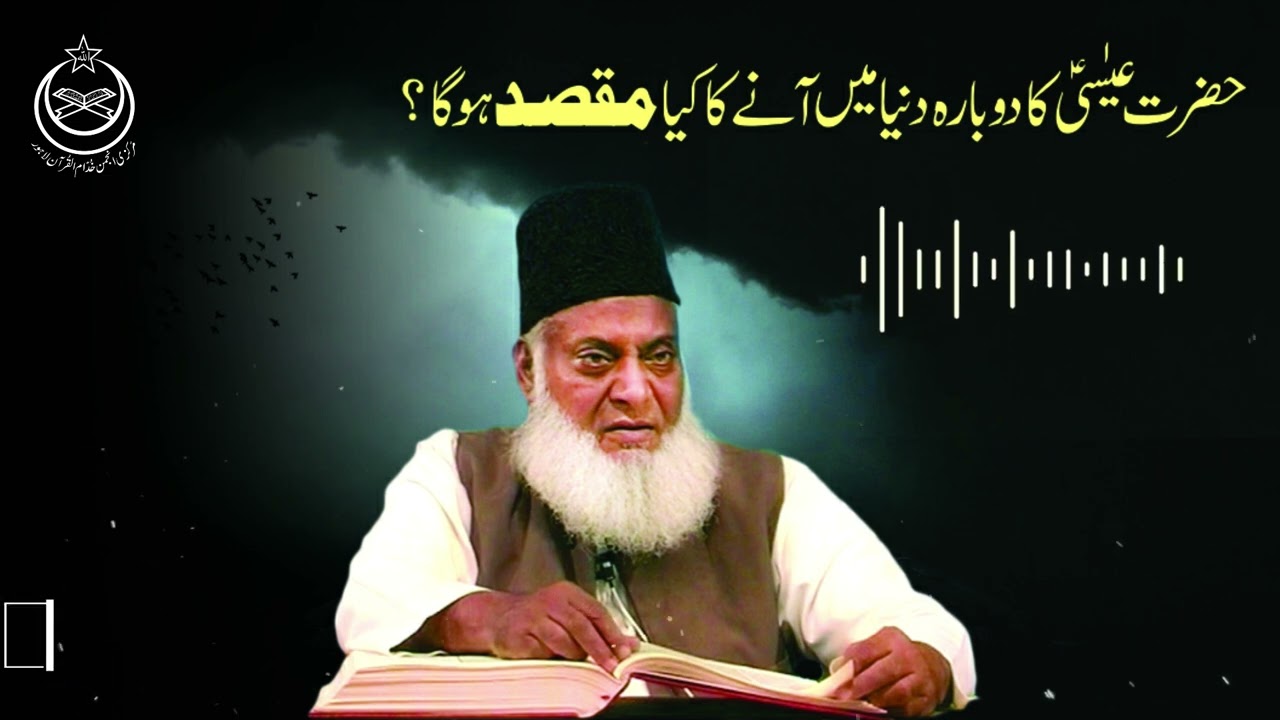
In this clip Dr Israr Ahmed says that when Hazrat Isa (AS) returns, he will join Muslims in prayer, showing respect for the Prophet Muhammad's (PBUH) followers. His main purpose will be to defeat those who opposed him, especially those with powerful weapons. Allah will give him special abilities so that his presence alone will weaken and defeat his enemies, helping to end falsehood and oppression.
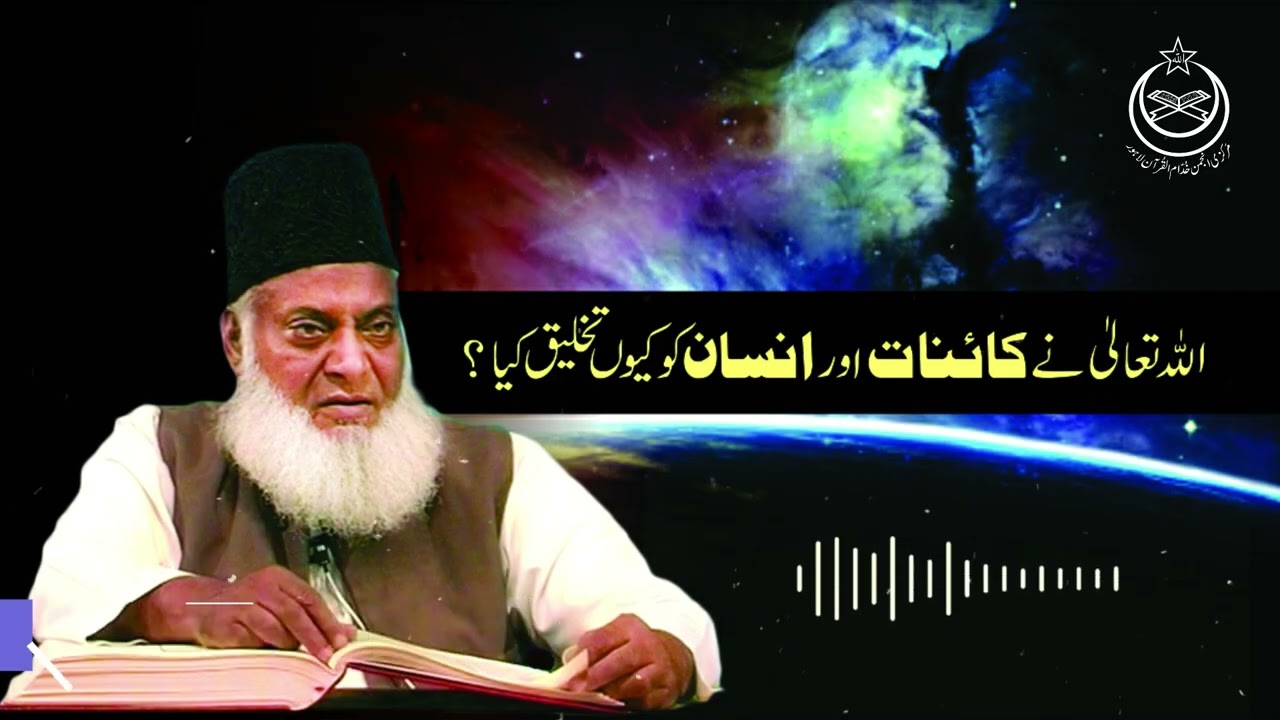
In this clip Dr Israr Ahmed explains that Allah created the universe and humans to show His creative power. Though we may not fully understand His wisdom, humans were created with the ability to recognize Allah's greatness. The final understanding of this comes through Prophet Muhammad (SAW), whose presence was essential for the creation of the universe. Without the Prophet, the universe would not exist.

In this clip Dr Israr Ahmed explains that the concept of eternal life in heaven (Jannah) and hell (Jahannum) is hard for humans to fully understand due to our limited minds. He mentions two scholars, Ibn Arabi and Ibn Taymiyyah, who both agree that heaven is eternal, but hell may not be. This debate comes from different interpretations of religious texts.

In this clip Dr Israr Ahmed explains that the Quran is a miracle because of its unmatched language, guidance for life, and scientific insights that were only discovered later. It amazed the Arabs with its beauty and wisdom, and even great poets admitted it was beyond human ability. The Quran's impact remains powerful today for both its message and depth.

In this clip Dr Israr Ahmed explains that the Quran does not say Hazrat Isa (Jesus) is alive, but it mentions that Allah took him to Himself. He will return in the future, as confirmed by authentic hadiths in Sahih Bukhari and Sahih Muslim. Both Muslims and Christians believe in his miraculous birth without a father. Hazrat Isa was sent to guide the people of Israel and will return to defeat their enemies.

In this clip Dr Israr Ahmed explains that some hadiths are called weak because expert scholars carefully checked the narrators’ honesty. These scholars spent their lives gathering and verifying hadiths to keep only the reliable ones. He highlights that, like the Quran, the Prophet’s teachings (Sunnah) have been preserved as a miracle, giving Muslims a lasting model and uniting them in core practices like prayer.

In this clip Dr Israr Ahmed explains that after Prophet Muhammad (SAW), Allah ensured Islam’s teachings would stay pure by protecting the Quran, sending people to revive the faith, and keeping a group of true believers within the ummah. This way, those seeking guidance can always find the right path, as shown by the story of Salman Farsi (RA), who searched far and wide for the truth, proving that finding true guidance often requires sincere effort.

In this clip Dr Israr Ahmed explains that true faith (yaqeen wala emaan) is developed in three ways: first, by spending time with good, sincere people, which naturally strengthens faith; second, by consistently practicing religious duties, which builds conviction; and third, by studying and reflecting on the Quran, which creates a deeper, more conscious understanding of faith. These practices lead to a genuine transformation and a strong, intellectual faith.